
The federal maritime land zone (ZOFEMAT) is a highly relevant space for certain projects, as it is often the main attraction for some hotels and real estate developments in coastal areas, since it is linked to what is commonly known as the beach.
The ZOFEMAT is the 20-meter-wide strip of land delimited by the Ministry of Environment and Natural Resources (SEMARNAT) from the maximum sea level (known as high tide), which must be passable and with an inclination of no more than 30°. Once the ZOFEMAT ends, there are the privately owned areas.
Federal Maritime Land Zone
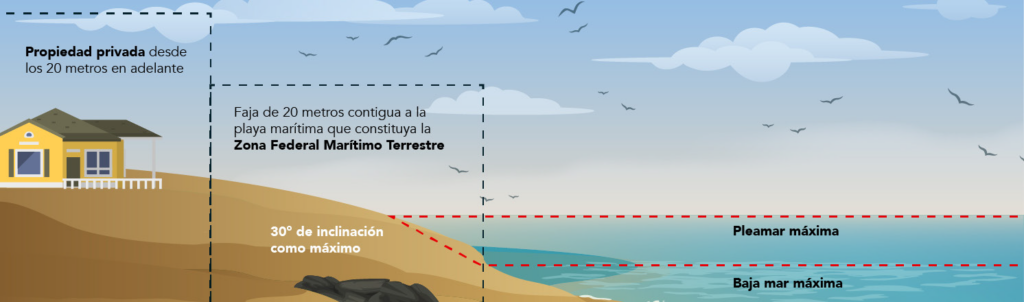
Although anyone can transit and use ZOFEMAT, if the intention is to have a private use to place some facilities or tourist works, such as swimming pools, beach clubs, sun loungers, among others, it is necessary to have a concession title issued by SEMARNAT.
It is important to mention that obtaining such a concession title and complying with the terms, conditions and bases established therein is a complex task. Based on our experience in this matter, we would like to make the following recommendations:
1. The ZOFEMAT changes according to the high tide. The maximum sea level is not definitive, therefore, the delimitation of the ZOFEMAT will depend on the delimitation carried out by SEMARNAT based on high tide.
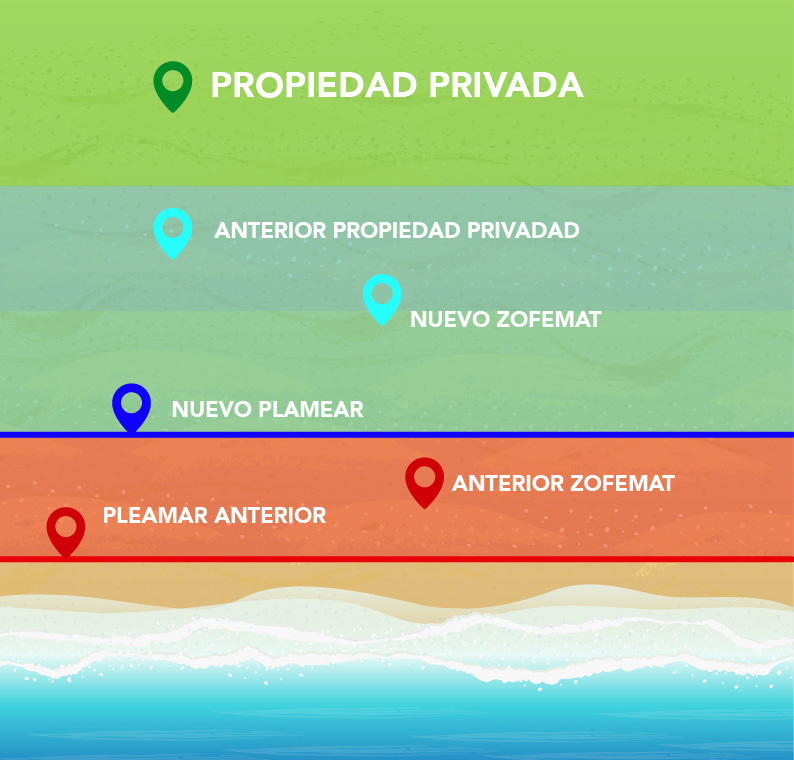
In this sense, if the high tide reaches land, SEMARNAT will establish a new delimitation of the ZOFEMAT, going inland. However, if the new delimited strip overlaps the property of third parties, these lands and their buildings will cease to be private property and will give way to the new ZOFEMAT, without any right to compensation for the former owner.
Based on the above, it is recommended that properties neighboring the ZOFEMAT be aware of the boundaries that SEMARNAT may establish regarding high tide and the ZOFEMAT, especially if they have built any work directly in the ZOFEMAT or close to it.
In the event that the ZOFEMAT affects private property, it is appropriate to request from the Secretariat the studies that led to the establishment of this new delimitation. If there is an error in these, it is possible to interpose some means of defense so that the authority recognizes the validity of the delimitation prior to the one that affects private property.
2. Only one concession can be issued for each ZOFEMAT slot. This is one of the most common reasons why SEMARNAT may deny the concession title, since some concession applications have partial or even total overlaps with other concessions previously issued.
3. It is not necessary to be the owner of the property adjacent to ZOFEMAT to obtain the concession on this strip. Anyone can apply for a concession title for a ZOFEMAT strip and carry out some economic activity in this area, for example, the provision of tourist services.
In this sense, if someone is a neighbor of the ZOFEMAT, it is recommended that they request the corresponding concession title from SEMARNAT to prevent third parties from carrying out economic activities in front of the property and, above all, so that in the future it is not the concessionaire who prohibits the development of economic activities in the ZOFEMAT by the owner of the neighboring property.
4. There are no private beaches. Being the holder of a concession only gives the right to carry out certain economic activities in the ZOFEMAT, in addition to the fact that the assets built and/or placed in this area can only be used by those permitted by the concessionaire, for example the lounge areas or tourist facilities. However, prohibiting the passage or use of the ZOFEMAT by persons not involved in the tourist development is a reason for SEMARNAT to revoke the concession title and impose fines.
5. Carrying out an economic activity in ZOFEMAT generates the obligation to obtain a concession title and pay fees. It is important to comply with this payment, as any non-compliance could lead to fines, updates and surcharges.
6. The use of ZOFEMAT indicated in the concession must be respected. The applicable regulations establish three possible uses for this area: (i) protection or ornamentation, which is recommended for the development of environmental preservation activities, in this sense, economic activities cannot be carried out there; (ii) some productive activity, such as fishing, agriculture, among others; and (iii) general use, which allows the development of all economic activities, including the construction of some projects.
It is important to mention that the payment of fees corresponds to the type of use for which the ZOFEMAT is intended. Fees in the protection and beautification area are quoted at up to MXN $45.57 per square meter, while for general use they amount to up to MXN $163.31 per square meter of ZOFEMAT.
7. If ZOFEMAT is used without a concession title or with an expired concession, administrative, fiscal and criminal liabilities could arise. We recommend that you be aware of the high tide and ZOFEMAT boundaries established by SEMARNAT and the term of validity of the concession title, which, even if it is about to expire, can be extended. It is important to mention that the loss of a concession entails the loss of rights for a specific use in the ZOFEMAT.
For the above reasons, it is recommended that the owners of the properties adjacent to ZOFEMAT obtain a concession title for it. In addition, adequate planning and legal advice are key to taking advantage of the use of this area, protecting the private property of adjacent projects and taking care of one of the main attractions of this type of project: the beaches.


Related articles

New Agreement on Additives and Processing Aids in Food, Beverages…

Digital Economy Bill Initiative for Digital Payments…
