
Executive Summary:
- On February 5, 2024, the then President of the Mexican Republic Andrés Manuel López Obrador, presented the Initiative with a draft decree to reform, add and repeal various provisions of the Political Constitution of the United Mexican States ("CPEUM"), in the matter of organic simplification.
- This reform initiative was aimed at to eliminate seven autonomous constitutional bodies("OCA's"), including the National Institute of Transparency, Access to Information and Protection of Personal Data and the Federal Institute of Telecommunications, with the purpose, according to the statement of reasons of the initiative itself, of rationalizing the public resources that were destined for the operation and functioning of the OCA's, in order to allow greater investment in social policies and programs (the "Reform").
- The Chamber of Deputies received the Reform initiative, which was discussed and approved as a Report by its Assembly on November 20, 2024, with modifications derived from the reservation presented by Deputy Ricardo Monreal. Subsequently, it was sent to the Senate for discussion and was approved on November 28 of this year. Finally, the Reform decree project was approved by the majority of the state legislatures, which allowed it to be sent to the Executive Branch for the purposes of its promulgation and publication in the Official Gazette of the Federation last Friday, December 20, 2024.
The Reform proposes the administrative reorganization of the Mexican State to align it with the principles of the current administration, essentially with a view to reiterated Republican austerity. In order to achieve this, the powers granted by the CPEUM to these OCAs will be transferred, within the scope of their respective subjects, to other public entities, most of which belong to the institutional structure of the Federal Executive Branch.
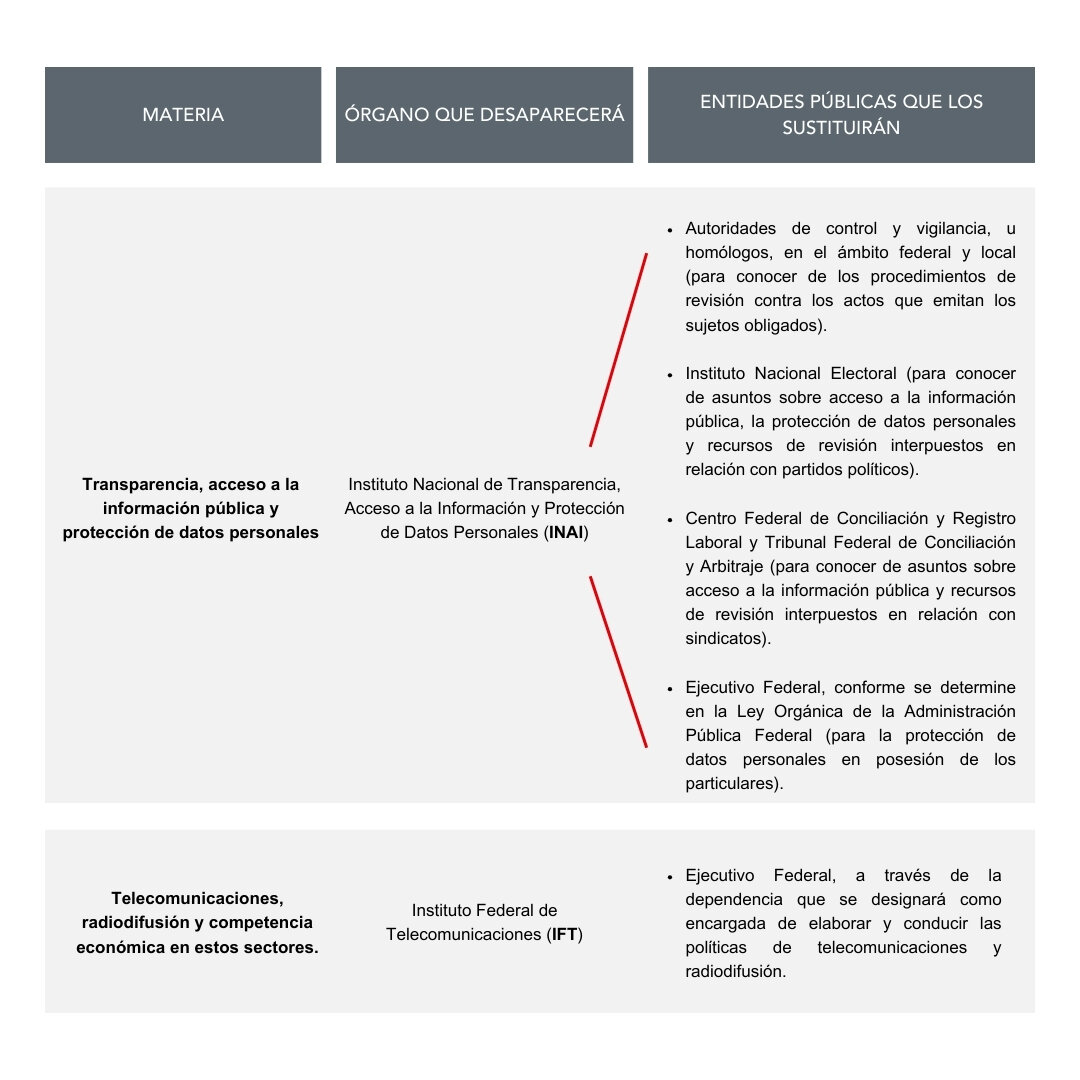
The subjects of the Reform, their guarantor bodies to date, as well as the public entities that will assume their functions, will be those indicated in the table included below. We note that the functions in matters of protection of personal data held by individuals have not yet been assigned to any private body:
¿What will happen with the financial resources that were destined for these OCAs and that will be saved with their disappearance??
The Reform indicates that the economies and savings generated by the extinction of these OCAs will be allocated to the Pension Fund for Welfare that is created in terms of the applicable legislation.
¿How long will it take to make adjustments to the corresponding laws to comply with the provisions of the Reform??
The Congress of the Union (Chamber of Senators and Deputies) has a period of ninety (90) calendar dayscounted from the entry into force of the Reform (that is, counted from December 21, 2024), to make the necessary adjustments to the secondary laws ("Secondary Laws") that correspond to comply with said Reform.
This involves making changes to the texts contained in existing laws, or the issuance of new laws that would govern matters of transparency, access to public information, protection of personal data (for both the private and public sectors), economic competition, telecommunications and broadcasting.
It will be important to monitor the adjustments that are made to the Secondary Laws of each of the subjects, in order to know with certainty the public entity that will ultimately assume the functions of protecting personal data held by individuals and its terms.
¿When do OCAs expire and until when do their legal acts cease to have effect??
The OCAs will expire once the Secondary Laws come into force. However, as for the IFT, they will expire 180 days after the Secondary Laws come into force.
Likewise, legal acts issued by the OCA's prior to the Secondary Laws coming into force will continue to have all their legal effects until they are concluded by the passage of time or in the manner established in said legal acts. These legal acts will be understood as being in force and will bind, in their terms, the substitute public entities that will assume the functions of the OCA's, as appropriate, without prejudice to the right of the parties to ratify, modify or rescind them later.
In particular, the enabling titles granted by the IFT will remain in force under their terms, without prejudice to the fact that the concessionaires and/or authorized parties must comply with the obligations and compensations that may be imposed on them by the Federal Executive, in the exercise of its powers.
¿How long will the current OCA Commissioners remain in office??
Commissioners who continue in their positions when the Reform comes into force (i.e., December 21, 2024) will conclude their functions upon the entry into force of the Secondary Laws, except for those whose term of their appointment ends previously. As for the IFT Commissioners, their functions will conclude up to 180 days after the entry into force of the Secondary Laws.
In cases where it is necessary to make a new appointment to integrate the quorum of one of the OCAs, the duration of this designation may not exceed the entry into force of the Secondary Laws.
https://dof.gob.mx/nota_detalle.php?codigo=5745905&fecha=20/12/2024#gsc.tab=0

Related articles

The Supreme Court of Justice of the Nation (SCJN) declares the current ISAI tax rate unconstitutional…

Hydrocarbons Sector Development Plan: New Fact Sheet…
