Go to main content
bigstock The Water Treatment Facility A 469159899

Water and Mining

Our country is one of the main recipients of investment in mining projects. During 2021, the mining sector made investments of 4 million pesos, an increase of 809% compared to what was invested in 36.1. [1]

However, mining activity has faced various criticisms arising from its impact on the environment, so it is common that the exploitation of some deposits can be hindered by social opposition. One of the most sensitive points for mining projects is the exploitation of water, since mining activity requires a large volume of water for its processes, where it is mixed with dangerous substances, for example, the leaching of minerals such as gold and silver using cyanide. 

Therefore, from the planning stage of a project and during its execution, its owners must consider and implement strategies to save water, prevent its contamination and not affect riverbeds. 

In this regard, in addition to the recommendations that any project may have regarding the use of water and discharge of wastewater, our professional practice has allowed us to identify some points that are advisable to verify, in order to guarantee compliance with its obligations regarding the use of water, among which are the following:  

1. Ensure the volume of water required for the mining project and consider future expansions. It is becoming increasingly common for the start or expansion of mining projects to be affected by a lack of water. In this regard, their holders must obtain national water concession titles issued by the National Water Commission (CONAGUA), in addition to ensuring their compliance to avoid losing them. 

It is advisable to explore other sources of water supply, for example, desalination of seawater and its conduction through aqueducts, or the use of wastewater from other industries close to the mining project. It should be noted that, in many cases, these types of alternatives also require permits from CONAGUA, the Ministry of Environment and Natural Resources (SEMARNAT) and other authorities. 

2. Promote hydraulic infrastructure works for the population that does not have this resource. Often, the society surrounding a mining project opposes its implementation due to the lack of water supply, even though there is water available for everyone. In this regard, it is advisable that the project owner supports or collaborates with other authorities for the construction of a drinking water network. 

It should be noted that this type of initiative can be considered as a measure to mitigate the impacts of a project and, thus, speed up the obtaining of some key environmental authorizations for mining operations. In addition, it will help the neighbors of the project to have a favorable opinion of it. 

3. The issuance of concession titles to exploit water may require indigenous consultation. This is especially true in areas where there are indigenous communities with precarious access to water. Failure to consult may result in communities initiating a legal defence that would compromise the water supply for the mining project.  

4. Exploitation of working waters [2] does not require a CONAGUA concession titleThe mining concession title issued by the Ministry of Economy allows the exploitation of working waters for mining activities. However, certain obligations must be met as if it were a CONAGUA concession title, including the payment of fees. If the use of working waters for the mining project is not required, it is advisable to reinject them into the subsoil to avoid CONAGUA demanding payment of fees. 

5. Build monitoring wells and detect any contaminants in time. These water quality monitoring wells, which will be located around the project, will help verify whether any substance is contaminating the groundwater. The construction of these wells requires permits from CONAGUA, especially if they are in restricted areas. 

6. Obtain certifications for the responsible use of some hazardous substances. To strengthen the comprehensive management of this process and prevent damage to the environment. For example, the certification of the cyanide code. 

7. Some water runoff is considered national property under the responsibility of CONAGUA. Mining projects require large spaces adjacent to the pit for the construction of tailings dams or leachate lagoons, so it is common for these facilities to be built on water runoffs that, regardless of their size, could be riverbeds. In order to build on them, a concession title from CONAGUA is required. 

In this regard, before building the facilities, it is recommended to verify with CONAGUA whether these runoffs are considered national assets under its responsibility and, if so, to process the corresponding concession title. 

Building without the corresponding concession could give rise to environmental, administrative and even criminal liability. In addition, buildings built on national property will be considered property of CONAGUA, which can preserve them or order their demolition. 

The mining sector is of great importance to the country. Some localities even depend entirely on this activity. However, mining project owners must consider the magnitude of their impacts on the environment and implement appropriate measures to prevent, mitigate or compensate for them. 


[1] Fuente: https://www.gob.mx/se/acciones-y-programas/mineria#:~:text=El%20sector%20minero%2Dmetal%C3%BArgico%2C%20en,(INEGI)%2C%20en%202021.

[2] Working water is groundwater found in a mining project.

bigstock Law Books And Scales Of Justice 467310193

SCJN will resume its jurisdiction in the appeals against the reforms to the LIE

Executive Summary:

  • The Second Chamber of the Supreme Court of Justice of the Nation (“SCJN”) decided to exercise its power to reassume jurisdiction to review certain appeals filed against the reforms to the Electricity Industry Law (“LIE”).
  • The requests for resumption were submitted to the SCJN by 18 companies.
  • The SCJN will have the possibility of declaring invalid certain elements of the reforms to the LIE.

Background

In March 2021, the Legislative Branch approved the reforms to the LIE sent by the Federal Executive with the aim of favoring the Federal Electricity Commission over the participation of the private sector in the electricity sector.

In April 2022, the Plenary of the SCJN resolved the unconstitutionality action 64/2021 and the constitutional controversies 44/2021 and 45/2021, promoted by 48 members of the Senate of the Republic, the Federal Economic Competition Commission and the government of the state of Colima, respectively. In all three cases, the plaintiffs demanded that the reforms to the LIE be declared unconstitutional.

In these proceedings, the SCJN analyzed, among other things, the imbalance that the reforms to the LIE generate in the electric sector to the detriment of private companies and end users, and the violation of the right to the environment and international treaties. However, the SCJN did not gather the qualified majority votes necessary to invalidate even a single article of the reforms to the LIE and expel said norms from the national legal order.

For this reason, the analysis of the constitutionality of certain articles of the reforms to the LIE was left open through the numerous amparo trials against them pending resolution and the new amparo trials that arise against the application of the LIE. In this regard, it should be noted that various federal courts have resolved amparos in favor of various companies against some articles of the reforms to the LIE.

Relevant Aspects

Thus, on January 25, 2023, the Second Chamber of the SCJN discussed and decided to exercise its power to reassume jurisdiction to review two amparo trials filed against the reforms to the LIE in which federal judges declared the reforms to the LIE unconstitutional in order to definitively resolve the merits of the cases. The requests for reassumption were submitted to the SCJN by two groups of 18 companies, most of them private producers of solar and wind energy.

Thus, the SCJN will have the possibility of declaring invalid the following elements of the reforms to the LIE:

  • Article 3:
    • Section V, referring to legacy power plants;
    • Section XII, referring to electricity coverage contracts;
    • Section XII bis, referring to electricity coverage contracts with a commitment to physical delivery;
    • Section XIV, referring to legacy contracts for basic supply.
  • Article 53, regarding electricity coverage contracts through auctions.
  • Article 108, Section VI regarding the powers of the National Energy Control Center.

In principle, the Second Chamber of the SCJN would be in charge of reviewing the appeals, but given the relevance of the issue, the appeals could be discussed in the Plenary Session of the SCJN.

There are no set deadlines for the SCJN to definitively resolve these matters and no minister has yet been assigned the task of preparing draft resolutions.

bigstock Wooden Judge Gavel And Stack O 465677067

Publication of new arbitration rules of the Mexican Arbitration Center (CAM)

In December 2022, the Mexican Arbitration Center (“CAM”) published its new arbitration rules, available for consultation here.

The Rules added novel aspects, putting themselves at the forefront for the resolution of commercial disputes.

One of the central points is innovation in the use of technologies. The possibility of sending communications by electronic means and holding hearings under a hybrid or completely remote scheme is now expressly provided for.

Another important point is in relation to the precautionary measures. Arbitration Tribunals are granted the power to preliminarily order the parties to maintain matters as they are, until the merits of the request for a precautionary measure are resolved.

The Rules also now provide for an obligation on the parties to disclose the existence of financing agreements (Third Party Funding). In addition, the application of the principles of impartiality and independence of the Arbitration Tribunal.

Finally, the new Rules provide for simplified arbitration, which involves an abbreviated process for cases whose value is less than 3 million pesos.

bigstock D Rendering Of North American 73539847

Key moment to protect investments under NAFTA

American and Canadian companies that have made investments in Mexico between January 1, 1994 and July 1, 2020 have time to file a claim against the Mexican State under the North American Free Trade Agreement (“NAFTA”).

In this regard, it is key to take into consideration that the Treaty between the United States of America, the United Mexican States and Canada (“T-MEC”), which replaced NAFTA, came into force on July 1, 2020. However, investments made in that period (January 1994 to July 2020) may give rise to investment arbitration under NAFTA.

The above is relevant, because while it is true that the USMCA also includes mechanisms for the resolution of disputes, it is possible that certain NAFTA rules grant investors a higher level of protection.

It is therefore critical that investors carefully consider whether they have any right to claim compensation from the Mexican State and, if so, whether it is more convenient to file such a claim under the rules of NAFTA.In the case of American investors-.

Investors who wish to take action because they believe their investment has been unjustifiably affected should implement certain preparatory actions before the April 1, 2023, in order to be able to avail itself of the protection of NAFTA.

Santamarina + Steta's dispute resolution team, together with the energy law department, has extensive experience advising clients on investment matters.

If you would like to explore the alternatives available to you to file a claim and protect your investments in Mexico, please do not hesitate to contact our experts.

bigstock Law Books And Scales Of Justice 467312779

STPS modifies provisions for the registration of individuals or legal entities that provide specialized services or execute specialized works (REPSE)

On February 3, 2023, the Agreement that modifies the various one by which the general provisions for the registration of individuals or legal entities that provide specialized services or execute specialized works referred to in article 15 of the Federal Labor Law (REPSE), issued by the Ministry of Labor and Social Welfare (STPS), were published in the Official Gazette of the Federation.

These provisions regulate the process of registration, denial, cancellation and renewal of the REPSE and now also the process of modification and updating of the same.

The modifications that stand out are the following:

  1. It will be necessary to attach to the registration application the last payroll receipt and the last receipt from the Single Determination System (SUA) issued by the Mexican Social Security Institute (IMSS) in PDF file.
  2. The STPS, through the Decent Work Unit, may request additional information or documentation at any time from the companies benefiting from the specialized services or works to corroborate and validate the information.
  3. Specific powers are granted to the Labour Inspectorate to review compliance with the rules on subcontracting in registered companies and in companies benefiting from specialized services or works.
  4. The violations that warrant the cancellation of REPSE are detailed, such as not having workers registered with the IMSS and irregularities in the payment of wages or in the content of contracts for the provision of specialized services.

This Agreement will enter into force on the day following its publication and can be consulted directly at the following link: https://dof.gob.mx/nota_detalle.php?codigo=5678731&fecha=03/02/2023#gsc.tab=0

bigstock Mexico City Mexico October 322632058

Closure of Cargo Operations at AICM

Executive Summary:

  • On February 2, 2023, the Federal Executive published the Decree establishing the closure of AICM for cargo operations. 
  • The decree excludes concessionaires and permit holders that provide combined passenger and cargo services.
  • Operators providing the exclusive cargo service will have a maximum period of 108 business days from the entry into force of the decree to relocate their operations outside the AICM. 

On February 2, 2023, the Federal Executive published in the Official Gazette of the Federation the Decree that establishes the closure of the Mexico City International Airport "Benito Juárez" ("AICM") for the operations of national and foreign concessionaires and permit holders that provide the public with regular and non-regular national and international air transportation service exclusively for cargo. 

The decree excludes concessionaires and permit holders that provide combined passenger and cargo services, provided that the cargo is transported on the same aircraft as the passengers.

As a result of the above, both the Federal Civil Aviation Agency and the AICM must update the general bases for the assignment of landing and takeoff times (slots) at the AICM. 

Operators providing exclusive cargo service at AICM will have a maximum period of 108 business days from the entry into force of the decree to relocate their operations outside AICM. 

The decrees, declarations and resolutions that (i) prohibit general aviation operations at AICM; (ii) establish the saturation of AICM and (iii) establish the saturation of AICM terminals, respectively, remain in force. 

bigstock Cigarettes And Judge Wooden Ga 452980609

Amparo lawsuits against the Regulations of the General Law for Tobacco Control

On December 16, 2022, the Regulations of the General Law for Tobacco Control (“Regulations”) were published in the Official Gazette of the Federation, which came into force on January 17, 2023. 

In this regard, the expansion of 100% smoke-free spaces is highlighted, through the prohibition of consuming any tobacco or nicotine product in spaces called "collective concurrence”, which correspond, among others, to places where food or beverages are consumed or served. In this regard, the Regulation introduces an absolute ban on the consumption of tobacco or nicotine, eliminating the possibility of having a space designated for tobacco consumption.

It is public knowledge that establishments dedicated to the sale of food and beverages have filed various amparo lawsuits against this absolute prohibition, which are still pending resolution. 

In this regard, it is worth noting that a District Judge granted a definitive suspension to the effect that the prohibition of the Regulation is not applicable to the person who filed the lawsuit until it is resolved. It is important to note that the authority can challenge the Judge's decision, which, if applicable, would be resolved by a Collegiate Court.

In this regard, we consider that the position upheld by the Judge, in granting the suspension, preliminarily confirms that the arguments of unconstitutionality are reasonable, and there is still the opportunity to file an amparo suit against the first specific act of application of the Regulation.

bigstock Power Line Support With Wires 469311833

Regulated Tariffs, Distribution and Transmission Tariffs for 2023

Executive Summary:

On February 8, 2023, the following agreements were published in the Official Gazette of the Federation (“DOF”):

  • The National Energy Control Center (“CENACE”) published the Notice in which the Regulated Rates are announced for the period from January 1 to December 31, 2023, or until the general administrative provisions are issued or the regulated rates are updated.
  • CFE Distribución published the Agreement that determines to continue with the extension of the validity of the initial tariff period of the public service of electric energy distribution and also determined the regulated rates of the distribution service applicable from January 1 to December 31, 2023.
  • CFE Transmisión published in the DOF the update of the rates that will be applied for the public service of electric power transmission during the period from January 1 to December 31, 2023 and until the general administrative provisions are issued.

Rates regulated by CENACE

As is well known, through Regulated Tariffs, CENACE obtains the income that allows the efficient and reliable operation of the National Electric System and the Wholesale Electricity Market, which guarantees open access to the National Transmission Network and the General Distribution Networks and must be approved by the Governing Body of the CRE for its subsequent publication and entry into force.

These rates were approved on December 20, 2022, through Agreement No. A/043/2022. This Agreement establishes that CENACE may request, in writing, from CRE the review and adjustment of the Required Income and the Regulated Rates for the CENACE operating service, which must be accompanied by supporting information and documentation.

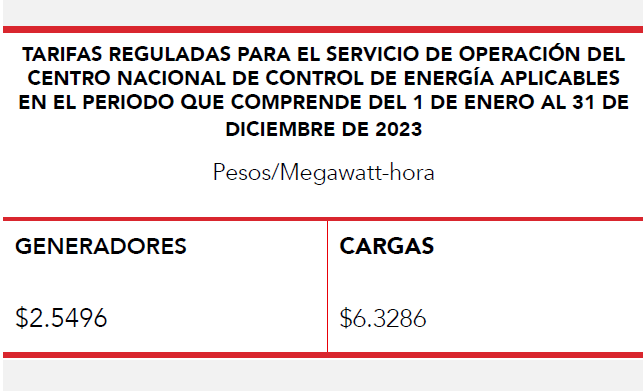
The rates that were approved for the operation service of the National Energy Control Center applicable in the period from January 1 to December 31, 2023 are the following:

 class =

Distribution Rates

During the extraordinary session of the CRE Governing Body, on December 23, 2022, Agreement A/051/2022 was approved, which establishes the continuation of the extension of the validity of the initial tariff period of the public service of electric energy distribution.

This Agreement also determines the regulated rates for the Distribution service applicable from January 1 to December 31, 2023, leaving without effect Agreement A/038/2021 of December 17, 2021 in relation to the determination of the Regulated Rates in distribution.

The rates that were approved for the electric power distribution service for CFE Distribución Empresa Productiva Subsidiaria de la CFE for 2023 are the following:

 class =

Transmission Rates

During the extraordinary session of the CRE Governing Body, on December 23, 2022, Agreement A/050/2022 was approved, which determines to continue with the extension of the validity of the initial tariff period of the public service of electric power transmission; and determines the regulated rates of the transmission service and of the related services not included in the wholesale electricity market applicable from January 1 to December 31, 2023.

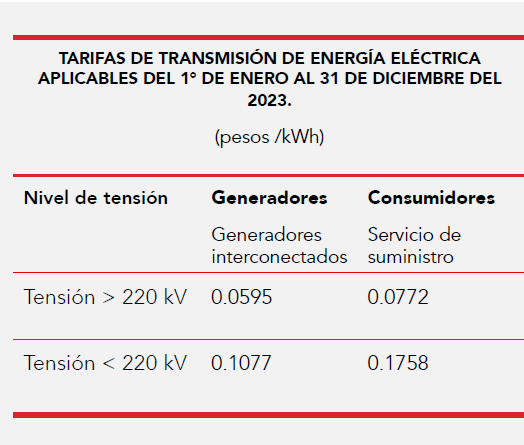
The rates that were approved for the public service of electric power transmission and related services not included in the wholesale electricity market during the aforementioned period are the following:

 class =
  1. The generator rate applies to all generators participating in the Wholesale Electricity Market, and for energy injections at the first interconnection point in the national territory associated with imports.
  2. The consumer rate is applicable to all Qualified Users participating in the Market, Suppliers and Marketers who acquire energy in the Wholesale Electricity Market or their representatives, and energy extractions at the last connection point in the national territory associated with exports.

The original publications can be found here:

bigstock Sustainable Energy Solar Farm 465153673

Resumption of legal deadlines and time limits at SENER

Executive Summary

  • On March 25, 2020, SENER established the suspension of legal deadlines and terms as a measure to prevent and combat the spread of COVID-19. 
  • On February 17, 2023, SENER published the Agreement resuming the legal deadlines and terms in the Secretariat.
  • This Agreement proposes resuming the legal deadlines and terms of all procedures, processes and any activity under the jurisdiction of SENER as of March 1, 2023.

On March 25, 2020, SENER published in the Official Gazette of the Federation (“DOF”) an Agreement establishing the suspension of legal deadlines and terms in the Ministry of Energy (the “SENER”) as a measure to prevent and combat the spread of COVID-19. 

The Agreement was modified three times and, finally, the suspension was extended indefinitely until it was determined that there were no epidemiological risks related to the gradual, cautious and orderly reopening of SENER's activities.

Thus, on February 17, 2023, SENER published in the DOF the Agreement by which the legal deadlines and terms in the Secretariat are resumed (the “Agreement”). Said Agreement proposes the following:

  1. Resume the legal deadlines and terms of all procedures, processes and any activity under the jurisdiction of SENER and its decentralized administrative bodies from the date of March 1th 2023.
  1. The legal deadlines for SENER that were interrupted during the suspension period (originally started on March 25, 2020) will be considered extended by the same number of days as the original period, so the actions, notifications, requirements, requests or promotions submitted to SENER during the suspension period will be attended to in accordance with their order of priority as of March 1, 2023, and priority will be given to those submitted before the date of publication of the Agreement in the DOF.
  1. To establish, with respect to the Social Impact Assessments received by SENER as of April 12, 2021, that the resolution deadlines provided for in article 40 of the General Administrative Provisions on the Social Impact Assessment in the Energy Sector will be computed considering the chronological order of presentation, under the legal principle of first in time, first in law, as of March 2, 2023.
  1. Confirm the operation, location and hours of operation of the Common Parts Office and indicate that the electronic systems corresponding to the handling of procedures by said means remain in operation.

The Agreement will enter into force on 1 March 2023.

The original publication of the Agreement can be consulted here: https://sidof.segob.gob.mx/notas/5679953

bigstock Coins In Human Hands And An Ar 471838797

Effective income tax rates for large taxpayers

Executive Summary:

  • Effective rates represent a measurement parameter for tax authorities and not for taxpayers, since their purpose is to “measure tax risks.”
  • If a taxpayer determines an income tax rate lower than the effective rate, the tax authority will inform the taxpayer that there is a tax risk, which does not necessarily imply non-compliance with tax provisions.
  • It is advisable to review the income tax determination for fiscal years 2020 and 2021, compare the result with the effective rate and, if there is a “tax risk”, review and determine whether there is documentary support to justify the difference.

Pursuant to Article 33, first paragraph, Section I, subsection i) of the Federal Tax Code, the tax authorities are empowered to disclose reference parameters with respect to the effective income tax rates presented by other entities or legal entities that obtain income and in accordance with the various productive sectors or subsectors of Mexico.

To date, three publications have been made corresponding to the fiscal years 2020 and 2021, and on February 14, 2023, the “Third publication of effective income tax rates for large taxpayers” was released. These publications can be found on the Mexican Government's website.

The purpose of publishing the effective income tax rates is to “measure tax risks”, that is, the contingency of non-compliance with the tax provisions that are applicable to a taxpayer or a group of taxpayers and that impacts the correct payment of contributions, specifically in the area of ​​income tax.

In this sense, the effective rates represent a measurement parameter for the tax authorities and not for the taxpayers, since based on the comparison made of said rates in relation to the situation of the taxpayers, the Tax Administration Service "may inform the taxpayer that it detected a tax risk based on the parameters established in the effective rates."

In this context, if a taxpayer determines an income tax that is lower than the effective rate, the tax authority will inform the taxpayer that there is a tax risk, which does not necessarily imply non-compliance with tax provisions; however, we consider that such a situation may provide an indication for the tax authorities to initiate their verification powers.

For the above reasons, it is advisable to review the income tax determination for fiscal years 2020 and 2021, compare the result with the effective rate published by the tax authorities and, if it is determined that there is a “tax risk”, review and determine whether there is documentary support to justify the difference.

We also recommend that you evaluate the tax results determined in fiscal years 2020 and 2021 to determine the areas of exposure and the steps to be taken to reduce the tax risks that may arise with respect to the effective rates published by the tax authorities.

bigstock 195269035

CRE declares the expiration of 128 permits for the marketing of petroleum products, petrochemicals and activities related to LP Gas

Executive Summary:

  • On February 20, 2023, the CRE published in the DOF two agreements declaring the expiration of a total of 128 permits related to the commercialization of petroleum products, petrochemicals and liquefied petroleum gas.
  • The expiration of permits does not release permit holders from compliance with their obligations and responsibilities under the permit during its validity.
  • The affected permit holders may challenge the resolution declaring the expiration in order to ensure that their permits remain valid.

On February 20, 2023, the Energy Regulatory Commission (“CRE”) published in the Official Gazette of the Federation (“DOF”) the following two agreements declaring the expiration of a total of 128 permits: 60 permits for the marketing of petroleum products and petrochemicals in accordance with Article 55, Section I, subsection b) of the Hydrocarbons Law (“LH”); and 68 permits for various activities related to liquefied petroleum gas in accordance with Article 55, Section I, subsection b) of the Hydrocarbons Law. 

The Hydrocarbons Law establishes that permits may expire (i) if the permit holders do not exercise the rights conferred within the established period or in the corresponding permit or, (ii) in the absence of an established period, if the permit holders do not exercise the rights for a consecutive period of 365 days.

In both cases, the expiration of permits is the consequence that the LH imposes on the permit holders of the regulated activities due to inactivity in the exercise of the rights conferred on them by the permit titles. For this to be valid, the following assumptions must be met:

  • The existence of a right that enables a person to carry out any of the activities regulated by the LH through the respective permit.
  • That the holders of the permits have failed to exercise the rights conferred upon them for three hundred and sixty-five consecutive calendar days.
  • The Commission's review and verification of inactivity in the electronic files associated with permit holders, in order to provide certainty about the passage of time that led to their configuration.

Given the above, the Agreement provides that, in accordance with the acts of supervision and monitoring carried out by the Commission, it was determined that the rights conferred in the permit title were not exercised for a consecutive period of at least three hundred and sixty-five calendar days, so that the Permit Holders identified in said Agreements are inactive and did not carry out any acts tending to preserve their rights, a situation that lasted for a consecutive period of more than 365 calendar days. In addition, a large part of the permit holders did not exercise their right to a hearing. 

The affected permit holders may challenge the agreements to defend their rights and seek to keep their permits in force, since the expiration can only be challenged through an indirect amparo trial, in accordance with Article 27 of the Law of the Coordinated Regulatory Bodies in Energy Matters.

For official publications, please visit: