Go to main content

Constitutional Reform to the Mexican Electric Sector

On February 5 of this year, then-President Andres Manuel López Obrador sent a package of constitutional reforms to the Chamber of Deputies, including the draft decree amending Articles 25, 27 and 28 of the Political Constitution of the United Mexican States regarding strategic areas and companies.

  • On October 31, 2024, the Ministry of the Interior published in the Official Gazette of the Federation the Decree amending the aforementioned articles.
  • On November 6, 2024, the National Strategy for the Electric Sector was released.
  • The issuance of secondary laws that give content to the reform is still pending, to be issued within a period of 180 days.

  1. Public enterprises: The reform reverses the legal nature of the Federal Electricity Commission (CFE) and Petróleos Mexicanos (PEMEX) from Productive State Enterprises to return to their status as public companies, eliminating the profitability requirement and focusing on the efficiency of the system.
  2. Prevalence and public service: Related to the previous point is the insertion in the reform in the sense that individuals will not be able to have precedence over CFE - whose essence lies in fulfilling its social responsibility and guaranteeing the continuity and accessibility of the public electricity service.
    • The references to the prevalence of CFE in a market open to competition in terms of generation and marketing, an openness recognized in the trade agreements to which our country is a party, as well as the reinsertion of a concept of public service, outdated more than ten years ago in a context in which open activities in terms of generation and marketing are carried out by private individuals based on permits granted by the regulatory body and not on concessions, with the legal consequences that such a distinction implies, are worrying.
  3. Private sector participation:The approved reform to the constitutional text indicates that secondary laws will determine the way in which individuals can participate in activities of the electrical industry.

The reality of the country shows us the lag suffered in recent years in terms of electricity generation and the clear need to rely on the private sector (only 7.5% of new capacity was contributed by CFE in the period 2028-2023).

In this regard, it would be expected that secondary laws would include new participation mechanisms for the private sector in electricity generation and marketing activities.

On the other hand, even though the reform eliminates from the constitutional text the possibility that the State may enter into contracts with private parties in transmission and distribution activities, we do not rule out that secondary laws may include some mechanism that allows the Mexican State to rely on the private sector for the construction and maintenance of efficient transmission and distribution lines.

The backlog in electricity generation must be added to factors such as the public finance commitments faced by the current administration and the need to modernize and expand the national transmission network and general distribution networks.
The signals sent by the government to the private sector with a proactive discourse and ambitious goals in the energy field suggest that the sector will give greater room to efficient participation of the public and private sectors.

The National Electric Sector Strategy includes relevant information related to private sector participation and investment plans in the sector:

  1. Public-private investment would reach 32.4 billion dollars in the next 5 years.
  2. Private companies are expected to install between 6,400 and 9,550 MW with investments of between 6 and 9 billion dollars.
  3. Private companies will be able to participate by: selling energy to CFE in long-term contracts, mixed production companies (public-private) and generating energy for the electricity market.
  4. The threshold for operating on-site without a permit will be increased to 0.7 MW and on-site consumption without surplus to the grid will be encouraged from 0.7 to 20 MW to promote development hubs and industrial parks.
  5. The administrative procedures in the sector will be simplified and digitalized.

It is recommended to be alert to these investment opportunities in the electricity sector derived from the content of the secondary laws on the subject and the details of the investment mechanisms and plans.

Interlomas facilities 20190305200607

Santamarina y Steta advises Fitness Ventures on investment from ACON Investments to boost its national and international expansion

Santamarina y Steta, SC, through Pablo Laresgoiti Matute and Sebastián Samayoa Steta, advised Fitness Ventures, SAPI de CV, one of the leading operators of fitness studios in Mexico, on the capital investment to accelerate its national and international expansion plans by ACON Investments, a private equity firm based in Washington, DC.

The transaction closed on October 30, 2024.

9

The use of artificial intelligence in dispute resolution

  • Artificial intelligence is revolutionizing legal practice, allowing tasks such as researching information and drafting documents to be done more quickly and cheaply. While these tools benefit both lawyers and clients, their use must be careful to avoid errors and preserve professional ethics.
  • While AI facilitates dispute resolution, it should not replace human judgment. When used appropriately, it can be a valuable support in the legal field, improving efficiency without compromising the quality of service.


We are in a globalized world, where technological developments and advances occur practically in leaps and bounds and have an impact -usually in a positive way- the lives of human beings, whether to solve a problem, satisfy needs or improve and streamline processes -among other issues-.

Throughout this year, the phenomenon we know as “Artificial Intelligence” has begun to take an increasingly leading role in our lives, with various virtual “Chat” platforms becoming very important technological tools for various sectors, such as education, literature, financial services, e-commerce, media, entertainment, technology services and even health care services, and more recently -and for what concerns us-, in the provision of legal services.

Will this be the beginning of the end for some of the professions involved in the use of these technologies? What will happen to teachers, accountants, journalists, writers, marketers? Lawyers? Are these professions that can actually be “easily” replaced by Artificial Intelligence tools?

The use of this type of technological tools is, without a doubt, an advance that perhaps from the beginning seemed very far away to be able to know and interact with in our lives. Today it is a reality, and at least from my perspective, we should not be “fearful” with such tools: quite the opposite. We must be proactive and use these tools, so that little by little they become relevant allies when doing our work as lawyers.

As I mentioned above, Artificial Intelligence and its technological tools are increasingly used by people in their daily lives. As lawyers, and with the recent advances in this type of tools, even if in smaller proportions, in one way or another we have heard of situations in which our colleagues use tools such as “ChatGPT” for different purposes: searching for information, rulings, jurisprudence, review and preparation of legal documents (including in some cases, claims, responses to claims, appeals, etc.), and even the creation of automated diagnostic systems and solutions to specific legal situations.

All of the above essentially also implies greater efficiency, less time and reduced costs for customer needs.

Thus, it is clear that although the advantages of using these tools are clearly visible and attractive, -both for those of us who practice the profession and for those people who require these services-, the truth is that its use must be done carefully and auxiliary to the profession that we practice, because at the end of the day, tools such as "ChatGPT" and similar, are nourished -in essence- of information contained in informative content published on the Internet. Let us take this technological tool as an example of teaching.

“…ChatGPT is a tool developed by the company OpenAI that works with GPT-3 artificial intelligence and that initially had the objective of offering real-time customer service. Something like the chats you find in many customer service departments, but with a much more advanced level of understanding, contextualization, naturalness and creativity.

That is, it is a virtual robot with which we can converse, a ChatBot, but unlike those used by some companies for their customer service, it is capable of generating text in a very coherent way and adapted to each context in a very similar way to how a human being would do it.

(...)

It's a kind of cross between Google and your smartest friend. It works on the basis of text, that is, questions and requests. However, unlike a search engine, which after asking for information you will get a list of web pages, when you ask ChatGPT something you get a fairly coherent text response adapted to your interlocutor...[1]

The above essentially summarises the functions of this Artificial Intelligence tool and it is no secret that today, lawyers around the world rely on “ChatGPT” in their daily work. The key is to know how to use it, to be clear about how it works, the purposes of its use and, as a personal recommendation, not to blindly trust it.

An example of the latter is the case of certain lawyers in New York, who apparently used “ChatGPT” in the preparation of legal documents that included citations of false cases, thanks to the search for said tool.[2]

The case of these lawyers has caused a stir among New York lawyers and the firm involved, to the point that the Manhattan Judge who was hearing the case imposed a financial penalty on the lawyers responsible in this unfortunate case.[3].

Our profession implies ethical and moral responsibility in the provision of our services, and this should never mean that the use of these tools replaces the value of our knowledge, experience and legal judgment, but rather that it is an aid. -consciously- for this, because otherwise, the use of such tools can overwhelm us and in some cases, even compromise our honorability and reputation.

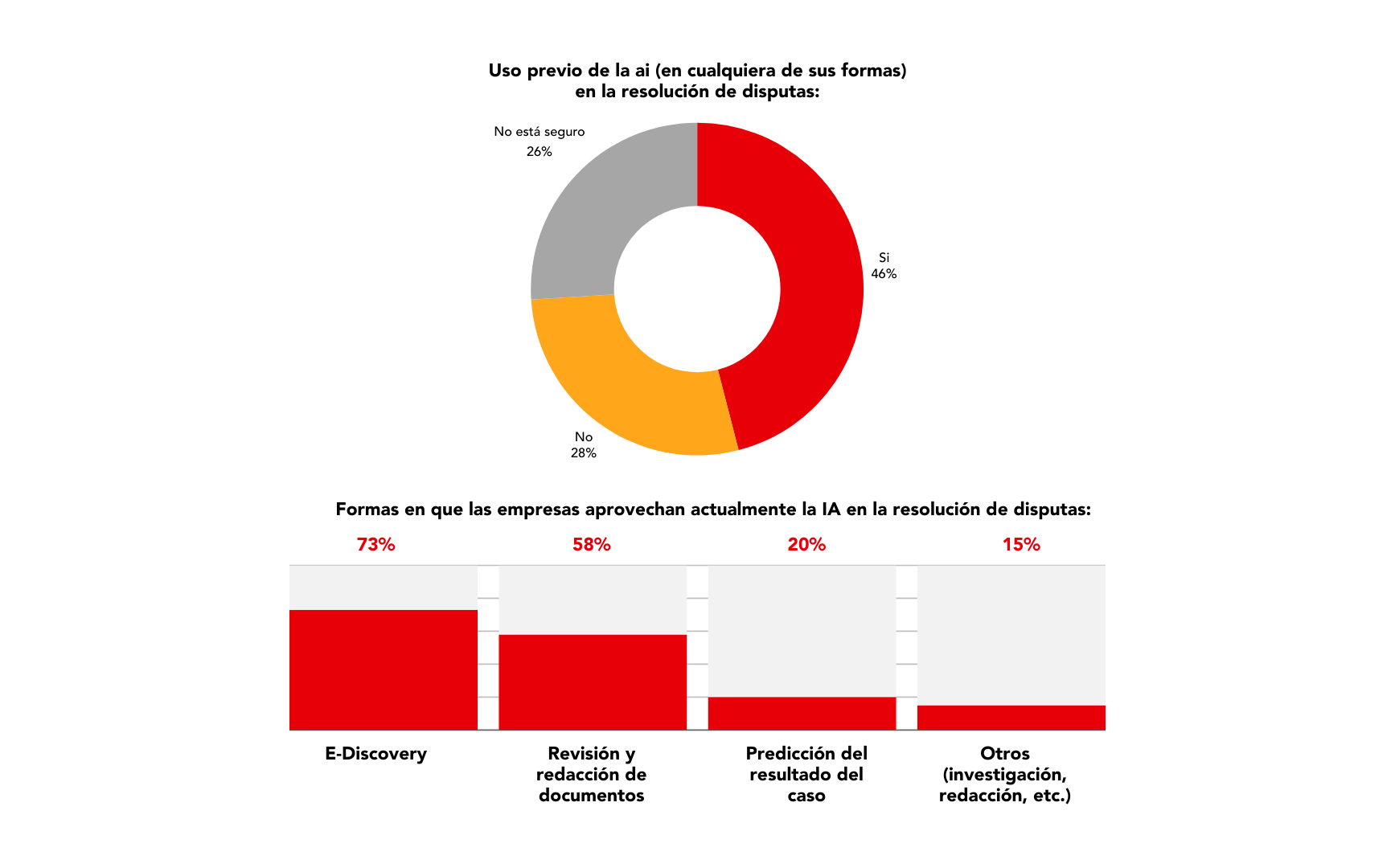
Having said that, it is clear that Artificial Intelligence in dispute resolution implies an opportunity that could be very advantageous for lawyers. Even so, the results of a survey conducted by “FTI Consulting” (https://www.fticonsulting.com/-/media/files/insights/reports/2023/nov/power-ai-navigating-paradigm-shift-dispute-resolution-services.pdf) showed which aspects of the field in which Artificial Intelligence tools are most commonly used by lawyers, these being “e-discovery” and the review and preparation of certain types of legal documents; however, to a much lesser extent, some lawyers have used technological tools as a mechanism for predicting the outcome of a case or other issues. Let's see:

Webpage SIZE

Thus, it will certainly be interesting to see how law firms around the world become more involved in the use of these tools day by day, so that dispute resolution becomes an important sector that greatly benefits from these issues, although always prioritizing the ethics that should surround our profession.


[1] https://www.forbes.com.mx/chat-gpt-el-chat-de-inteligencia-artificial/

[2] https://www.abajournal.com/news/article/judge-finds-out-why-brief-cited-nonexistent-cases-chatgpt-did-the-research/

[3] https://expansion.mx/tecnologia/2023/06/24/abogados-que-usaron-chatgpt-fueron-multados

11

Challenges and implications of requesting the Recognition and Enforcement of the Award before a Mexican Court when the procedure was followed in absentia

  • The recognition and enforcement of an arbitration award may be denied in Mexico if there are irregularities in the notification of certain actions within the arbitration procedure, since due process –as a constitutional principle– requires that the defendant be properly notified, unlike the flexible practices of arbitration.
  • The trend of the Mexican Courts prioritizes a correct notification over the flexibility that arbitration allows; when it comes to analyzing the validity of the arbitration award within a request for recognition and enforcement of the award.


The request for recognition and enforcement of an arbitration award before a jurisdictional authority implies that it must have certain characteristics that allow its validity to be concluded and, consequently, its adherence to the law in harmony with the legislation where its enforcement is sought.

Although it is true that an arbitration award enjoys a presumption of validity, article 1462 of the Commercial Code defines those scenarios in which its recognition and execution may be denied. Among the cases of invalidity, we highlight the content of section b, section I of article 1462, consisting of the improper notification of certain actions within the arbitration procedure, such as the designation of the Arbitration Tribunal, Procedural Orders or even the notification at the beginning of the arbitration procedure.

The regulations of the vast majority of regulations belonging to arbitration institutions allow notifications to be made by any possible means, as long as it can be verified that they have actually been delivered, and in some cases, it is sufficient to verify that it has been delivered to the address of the party to be notified.

That is, in contrast to Mexican legislation that regulates the location as one of the "Essential Formalities of the Procedure"where notification of the claim constitutes one of the most important acts that guarantee the defendant a true right of access to justice and that he can oppose the claims –This principle is also enshrined in due process, which seeks to ensure that the defendant has adequate means of defense.-.

And on the contrary, through the arbitration procedure, said "Essential Formalities of the Procedure"and allows for more flexible regulation, essentially due to the fact that notifications can be made by any possible means, as long as their effective delivery is recorded.

In practice, there is unfortunately a latent possibility that the Respondent may opt for a strategy of continuing the arbitration procedure in absentia if certain inconsistencies emerge from the notifications made.

Now, if one of the parties requests in court the recognition and enforcement of the award, the judge's attitude –which is initially aimed at decreeing validity and ordering its execution– may be prevented from doing so if it detects any irregularity that may compromise the validity of the award.

Among the most common reasons that are noted when the procedure was carried out in absentia, there is a potential irregularity in the notifications. For example: that it was not delivered to the correct address or that the notifications were made only by electronic means.[1].

From the jurisprudential development of the Mexican courts, the judges have adopted a protectionist position that involves ensuring due process and guaranteeing the parties the full opportunity to assert their rights –Even when the parties have waived the formalities in the notifications and have expressly submitted to the arbitration rules.-

In this sense, the conclusion that the Mexican courts have reached –and in light of the principles of due process and the guarantee of treating the parties equally and with full opportunity to assert their rights[2]– is that the arbitration award must be analyzed based on due process principles, preferring an interpretation that seeks to safeguard the defendant's potential notification rights over the flexibilities provided for in the arbitration.

Therefore, if irregularities are noted in the notifications of an arbitration procedure –or the rules provided for in the regulation are diametrically different from the lex arbitri– then there is a high risk that the award will not be recognized as valid or enforced.


[1] As an example, the articles 2.1 and 2.2. of the UNCITRAL Arbitration Rules allows notifications to be made only by email.

[2] Article 1434 of the Commercial Code: “The parties must be treated equally and each must be given full opportunity to assert its rights.”

10

Advantages of the Contractual Agreement of a Conventional Commercial Procedure before Judicial Courts

  • Nowadays, there is a need to resolve commercial disputes before the courts in an increasingly agile, rapid and efficient manner.
  • The Conventional Commercial Procedure (“PCM”) is a means to ventilate and decide controversies arising from a commercial act both before Judicial Courts and before an arbitrator, with the main characteristic that it is designed by the parties as opposed to those contemplated in the legislation.
  • The advantages of a PCM contractual agreement before the Courts of Justice are mainly focused on the simplification of a process and benefits the protection of confidential information.  


In Mexico, it is a well-known fact that the Courts that process Commercial Trials, both at the Local and Federal level, are saturated with workload for different reasons, which causes significant delays in the administration of justice.[1].

Likewise, the above is increased in the current context of the Labor Strike of the Judicial Branch of the Federation in protest of the so-called "Judicial Reform" of the Federal Constitution, which we at Santamarina + Steta, SC have analyzed in another publication that we invite you to consult.[2].

Likewise, in the applicable commercial procedural legislation, that is, the Commercial Code, procedures are established that, sometimes at the discretion of those governed, generate practical complications and a considerable investment of time.

An example of this is the summons to trial in a procedure, since when a commercial claim is admitted, a considerable investment of time is required for the management of the notification in the traditional method contemplated. Basically, it consists of an official, called a judicial attorney, personally going to the defendant's address. A dynamic that not only involves time, but takes even longer if the opposing party is no longer located at the address considered there.

In contrast to the above, there is a clear and growing need for people engaged in commerce to have access to some judicial procedure to resolve their disputes in an agile, rapid and efficient manner. As well as, to the extent possible when involved in a judicial process, to protect their personal information.

Therefore, it is relevant to consider, as part of a solution to the aforementioned problems in a judicial process, the contractual agreement of a conventional commercial procedure to resolve commercial disputes between parties.

Definition and requirements

The PCM is a means to ventilate and decide disputes between parties on the occasion of an act of commerce, regulated in articles 1051 to 1054 of the Commercial Code, in which the parties are empowered to freely agree on a procedure and rules that govern their actions before judicial courts or an arbitration procedure.

In the PCM agreement, the parties may freely design a procedure other than those contemplated in the Commercial Code, with rules adapted to their preference, even with respect to past, present and future disputes.

The above only under the limitation of respecting the essential formalities of the procedure, which in summary are: i. notification of the procedure; ii.  opportunity to offer and present evidence; iii. opportunity to argue; and iv.  the issuance of a judgment that resolves the differences; as well as the requirement that said agreement be recorded in a public deed before a Notary Public or a policy before a Public Broker.

Notable advantages of the PCM before Judicial Courts

  • For the purposes of the procedure, the parties are empowered to agree to exclude any means of evidence.

This can be beneficial, for example, in preventing people from not testifying, refraining from providing confidential information even when requested by one of the parties, such as accounting books and tax returns.

It would also be possible, for example, to limit the number of expert evidence presented, such as reducing it to just one expert, even identifying who it would be from the agreement (instead of the traditional three).

  • The parties may modify the terms and deadlines to be followed during the trial (for example, making them shorter than those provided for by law).
  • The parties may modify or waive the legal remedies provided for in the regulations during the course of a procedure (provided that the essential formalities of the procedure are not affected).
  • It is possible to make notifications by email in a PCM, including the summons to trial, after the Judge has confirmed, through the respective public servants, its remittance and/or receipt (Jurisprudence with registration 2019966).

Conclusions

Therefore, the contractual agreement of a PCM before judicial courts, under a clause wording that meets the aforementioned requirements, benefits in the simplification of a judicial process and can protect the confidential information of the parties.

Although the agreement of a PCM before Judicial Courts is not yet common in contracts, it is not ruled out that in the near future its use will become more frequent and to the extent that merchants become aware of its convenience, given that it represents part of a solution to the problems indicated in the introduction of this article,

Likewise, it is important to mention that even when there is a clause on a PCM in a contract, there is still the possibility of challenging its validity by the parties, either due to defects inherent to the contract or due to the violation of the essential formalities of the procedure, via an incidental route and without suspension of the main trial.

Finally, for more information on the Conventional Commercial Procedure, we invite you to contact our experts.


[1] https://animalpolitico.com/politica/reforma-poder-judicial-jueces-rezago-expedientes

[2] https://www.santamarinasteta.mx/publicaciones-y-eventos/articulo/reforma-al-poder-judicial-retos-estrategias-para-su-implementacion/?utm_source=hs_email&utm_medium=email&_hsenc=p2ANqtz-93KkXmm9QIsn9Zf_X30cM0qROtnv8-GoEJk4-PK5tCB_UAOJvB8OGpTZX1P5eFDv3n2su8

Natural,Cosmetics,Factory,Assembly,Line

Santamarina y Steta, SC advises KDC/ONE on cross-border refinancing of $1.8 billion

Knowlton Development Corporation, Inc. (kdc/one), a global provider of value-added solutions for brands in the beauty, personal care and home care industries, obtained a US$1.8 billion multi-currency cross-border revolving credit facility. The facility was subsequently refinanced and increased in its dollar and euro commitments to creditors.

Santamarina and Steta, SC., led by partner Aaron Levet, associate Raziel Celis and supported by Gerardo Prieto, together with Davis Polk & Wardwell LLP as co-counsel and transaction leader, acted as external legal advisors to kdc/one and its Mexican subsidiary Zobele México, SA de CV, in the transaction.

Zobele México, SA de CV, strengthens its commercial offering in Mexico and expands the geographic reach of kdc/one to provide value-added solutions for leading brands in the beauty, personal care and home care industries, serving more than 1,000 different brands and participating in the co-production of more than 3,000 products around the world. 

NADBank grants sustainable credit in favor of Sofoplus and Plus Leasing

NADBank grants sustainable credit in favor of Sofoplus and Plus Leasing

Santamarina y Steta, SC, advised the North American Development Bank (NADBank), a bilateral financial institution established and capitalized by the Governments of Mexico and the United States andIn the structuring and granting of a green loan for the benefit of Sofoplus, SAPI de CV, SOFOM, ER, and Plus Leasing SAPI de CV, with the aim of promoting environmental and sustainable initiatives in the region.

We appreciate the trust placed in us by the North American Development Bank to support them in this important operation.

The Santamarina and Steta, SC team involved in the operation was made up of the partners Sergio Chagoya y Diego Ostos, and by the associates Elias Zaga e Ines Buenrostro.

SEMARNAT

The guidelines and priorities of the new SEMARNAT

  • On October 4, 2024, the new head of SEMARNAT presented the main guidelines that will guide her management, focused on strengthening sustainable development, environmental justice and the protection of biodiversity.
  • He stressed that he will promote innovative projects and demand that environmental value be present in all stages of the projects, seeking to balance development and infrastructure with environmental conservation.


On October 4, 2024, the new head of the Secretariat of Environment and Natural Resources (“SEMARNAT”), Biologist Alicia Bárcenas Ibarra, gave a welcome message to the new officials who will fill some of the most important positions in the agency, as well as the heads of the Federal Attorney's Office for Environmental Protection (“PROFEPA”), the National Water Commission (“CONAGUA”), the National Agency for Industrial Safety and Environmental Protection of the Hydrocarbon Sector, among others; so we can say that the most important decision-makers of the national environmental policy were present at said meeting.

In this message, the head of SEMARNAT outlined the most important axes of her administration, which will surely guide the actions of all environmental authorities, so it will be important to consider them when generating projects in Mexico, or reinforcing those projects that already operate in our country.

That said, at Santamarina and Steta we make sure that you keep them in mind and we decided to list them, accompanied by some general strategies for their compliance. In addition, we will periodically publish a guide to specifically address each of them, along with advice for their compliance:

  1. Strengthening sustainable development: During the environmental impact assessment, more concrete and effective strategies for compensating environmental impacts should be considered in order to obtain an environmental impact authorization.
  2. The appropriation of natural resources should not generate inequalities: Social impact assessment and/or indigenous consultation are excellent tools for understanding how a project can impact a community and transform adverse impacts into genuine opportunities for individual and collective development.
  3. Environmental justice: which means that PROFEPA will have to reinforce its inspection and sanctioning work, in addition to closing down polluting projects. For this reason, it is important to carry out environmental audits. preventive, implement improvement plans and ensure that the terms and conditions of permits, authorizations and licenses are in compliance, otherwise, it is better to voluntary and preventive regularization, which is a regularization resulting from an inspection.   
  4. Prevent and repair environmental damage: Environmental impact assessments may be more stringent, but the restoration of rivers, soils and/or forests may also be an attractive compensation measure that allows projects to be approved.
  5. Protect biodiversity: In addition to environmental impact measures, this administration may more effectively use instruments to protect traditional natural resource practices.[1], may be more restrictive regarding activities with genetically modified organisms.
  6. Sanitation of water and related ecosystems: Like PROFEPA, this means that CONAGUA will implement more aggressive inspection and sanction actions, which may lead to the closure of activities that generate polluting water. Therefore, we recommend ensuring proper compliance with the discharge permit, especially with regard to possible particular discharge conditions that may exist in the permits. In addition, investments should be made to improve the wastewater treatment plant.
  7. Internalize past, present and future impacts: This point could be controversial, since SEMARNAT could try to make current companies responsible for past pollution. In principle, this regulation should not scare anyone, since it is a provision that has been in law for several decades. However, it is more important to know the history of the place where a project is going to be developed in order to know if there is an environmental liability (historical pollution), so the preparation of baseline studies or "phase I” should be common practice before starting a project.
  8. Projects require incorporating environmental value from their designEnvironmental compliance must be present in all stages of a project, from design, operation and abandonment.
  9. Promoting innovative projects: Those projects that manage to demonstrate some innovative environmental protection measure will be able to more easily pass the corresponding evaluations and obtain their authorizations.
  10. Stewardship of natural resources: This concept must be understood in relation to the natural resources over which SEMARNAT and the environmental authorities have jurisdiction, which are listed below, accompanied by some tips:
  • Water: In this case, CONAGUA has been prioritizing those concessions related to projects that can demonstrate that they will not cause overexploitation of aquifers, so we believe that this policy will continue.
  • Federal Maritime Land Zone: In this case, SEMARNAT could give priority to those concessions that ensure public use of the beach.
  • forests:SEMARNAT has been imposing conservation or reforestation measures beyond what the law states, for example, conserving vegetation on 30% of the land, so these measures may continue. 

These guidelines should not be understood as a prohibition on the development of infrastructure in the country, but rather as a measure to protect ecosystems. Compliance with these guidelines will help ensure that projects are more likely to be authorized and developed in favorable social environments, reducing the risk of closure.


[1] This is the case of the Nagoya Protocol, which regulates the distribution of benefits in cases where techniques or products used in traditional ways by communities are used.

Wide,View,Image,Of,Businessman,Hand,Stopping,Collapsing,Dominos,In

Reform to the Civil Code of Mexico City that impacts Mediation Agreements

Executive Summary:

  • Legislative Amendments:The reform of September 27, 2024 to article 3044 of the Civil Code and articles 50 and 79 of the Registry Law eliminates the possibility of closing the real estate registry through mediation agreements, seeking to protect the right of access to the registry of all citizens.
  • Impact on the Property Registry:With the elimination of the registration closure, it is expected that mediation agreements can no longer prevent the registration of liens or restrictions on a property, which could affect legal security in the transaction of property.
  • Recommendations for Stakeholders: Individuals and entities entering into mediation agreements are advised to consider that, following the reform, new liens may arise in the registry that affect the ownership or compliance with the established agreements, highlighting the importance of adequate legal advice.

On September 27, 2024, a decree was published in the Official Gazette of Mexico City amending article 3044 of the Civil Code for Mexico City (“CC”) and articles 50 and 79 of the Registry Law for Mexico City.

Article 3043 of the CC provides that the Agreements arising from mediation procedures that meet the requirements set forth in the Alternative Justice Law of the Superior Court of Justice of Mexico City shall be preventively recorded in the Public Property Registry.

Regarding the latter, prior to its reform, the second paragraph of article 3044 of the CC provided that the annotation or registration of acts in the real folio of a property would be prevented –what is known as registry closure-, if it were so agreed in an Agreement arising from a mediation process that was registered with the Public Property Registry. Thus, essentially, the registry traffic could be closed by means of an agreement between private parties, until such time as the Mediator or an official of the Alternative Justice Center requested the Public Property Registry to cancel the closure of the registry, once the parties were satisfied that said Agreement had been fulfilled.

In this regard, Articles 50 and 79 of the Registry Law for Mexico City were also amended, eliminating the possibility of closing property registries by virtue of Agreements arising from mediation procedures.

This reform seeks to prevent the sole and absolute will of the individuals who submitted to the mediation procedure from causing the closure of the registry of the real estate folio. This change is carried out under the perspective that the figure of the registry closure would be contrary to the human right of other citizens to access the registry, which could even lead to certain acts susceptible to registration falling into informality.

In other words, the particular interest of those mediated in an Agreement cannot be placed above the general interest of the community and the human right of access to the register.

Given the change described, it is advisable that people –physical or moral– those who enter into a Mediation Agreement should take into account that, with the entry into force of this reform, the door could be opened to the registration of liens on the real estate folio designated as a form of payment or as collateral in an Agreement of this type, which could have a better priority for payment or which restrict the possibility of transferring ownership of the property, which could affect the due compliance of Mediation Agreements.

Mexico,City,,Mexico,July,19,2023 ,Upper,Room,Of,The

From reform initiatives to secondary laws for the implementation of the Constitutional reform to the Judiciary

Executive Summary:

  • On September 15, 2024, the Constitutional Decree regarding the Judiciary was published.
  • In this regard, in order to achieve the gradual implementation provided for by the Decree, on October 7, 2024, the Head of the Federal Executive sent to the Senate two initiatives to reform secondary laws to detail the process of popular election of the judges that make up the Judicial Branch of the Federation.

On October 7, 2024, the President sent to the Senate two initiatives to reform secondary laws in order to establish the mechanisms and formalities for the election of judges, magistrates and ministers, which will take place on June 1, 2025, by general vote.

The initiatives refer to the General Law on Electoral Procedures and Institutions, and to the Law on Means of Appeal in Electoral Matters, in order to establish the rules, procedures, calendar to follow and the stages of the electoral process from its beginning to the declaration of validity.

The reform is intended to ensure that the General Law on Electoral Institutions and Procedures covers the preparation of the election, the call for elections, the nomination of candidates, the election day, the counting and summation, the assignment of positions, the qualification of the election and the declaration of validity, as well as the electoral campaigns, with an emphasis on citizen participation and a culture of participatory democracy.

In this regard, it is expected that the Ministers of the Supreme Court of Justice of the Nation, Magistrates of the Superior Chamber and Regional Chambers of the Electoral Tribunal, Magistrates of the Judicial Disciplinary Tribunal, Magistrates of Circuit Collegiate Courts and Collegiate Courts of Appeal, District Judges of the Judicial Branch of the Federation, as well as Magistrates of the Judicial Branches of the federal entities will be elected by relative majority and direct vote of the citizens.  

In this regard, elections will be held on the first Sunday of June of the year corresponding to the electoral processes in which any of the Chambers of the Congress of the Union is renewed, in accordance with the following:

  • The election of the Ministers of the Supreme Court of Justice of the Nation, Magistrates of the Superior Chamber of the Electoral Tribunal, Magistrates of the Judicial Disciplinary Tribunal will be carried out at the national level.
  • For their part, the Magistrates of Circuit Collegiate Courts and Collegiate Courts of Appeal, District Judges of the Judicial Branch of the Federation, will be elected by judicial circuit within the territorial scope determined by their jurisdiction. 
  • The Magistrates who make up the Regional Chambers of the Electoral Tribunal will be elected by plurinominal constituency.
  • Finally, the Magistrates and Judges of the Judicial Branches of the federal entities will be elected within the geographical framework determined for this purpose by the local constitutions and laws.

For the purposes of the above, the law provides the following stages for the election process:

  • Preparation and organization of the election:

This stage begins with the first session held by the General Council of the National Electoral Institute (“INE”), in the first 7 days of September of the year prior to the election, and concludes at the beginning of the election day.

In this regard, the powers of the General Council of the INE are as follows: (i) approve the ballot model, documentation and electoral materials; (ii)  approve the guidelines or agreements necessary for holding the election; (iii) issue austerity measures and budgetary discipline; (iv) carry out the election counts; (v) manage and distribute the time that corresponds to the State in radio and television, (vi) ensure that no candidate receives public or private financing for their campaigns, (vii) organize and develop forums for debate among the candidates, (viii) determine the maximum limits on personal campaign expenses applicable to each candidacy, (ix) supervise that no political party or public servant carries out acts of proselytism or positioning for or against any candidacy, (x) ensure equity in the development of campaigns, among others.

It is important to note that the reform prohibits the modification of ballots in the event of the substitution of one or more candidates, when said ballots are already printed.

  • Call and Application for Nominations:

This stage begins with the publication of the general call for candidates issued by the Senate of the Republic and concludes with the submission by said legislative body of the list of candidates to the INE.

In this regard, the Senate of the Republic, within 30 days following the start of the first ordinary period of the year prior to the corresponding election, will issue a general call to the Powers of the Union to integrate the list of candidates.

The Call must contain the following elements: (i) applicable constitutional and legal grounds; (ii) title of the positions subject to election, number of persons to be elected by type of position, term of office, as well as specialization by subject matter, judicial circuit or plurinominal constituency; (iii) requirements for each type of position, in the terms established by the Constitution, (iv)  territorial scope for which the judges will be chosen, (v) stages and dates of the election process, application and closing of the call.

Once the Call for Applications has been published by the Senate, each branch of the Union must set up an Evaluation Committee within the following 15 days. Each Committee will be responsible for compiling the lists of candidates who have responded to the call for applications and meet the constitutional eligibility requirements.

The General Council of the INE must approve, no later than December 31 of the year prior to the election, the deadlines and terms for the use of the electoral register and the Electoral Nominal List.

In addition, it is specified that the general call may not establish additional requirements to those established by the Constitution for the integration of said lists, as well as that the Senate of the Republic will be prevented from ruling on the eligibility or suitability of the applications that are sent to it by the Evaluation Committees, and must limit itself to sending the lists and files to the National Electoral Institute no later than February 12 of the year of the corresponding election.

  • Election Day:

The voting day begins at 8:00 a.m. on the first Sunday in June of the corresponding year and concludes with the counting of votes in the voting booth. In this regard, the INE is envisaged as the body responsible for the organization, development and counting of the election.

During the time that includes electoral campaigns (i) Candidates are expressly prohibited from receiving public or private financing for their campaigns, (ii) exceed the maximum personal expenditure limits applicable to the application being submitted, (iii) hire, either themselves or through an intermediary, spaces on radio, television, the Internet or any other means of communication to promote their candidacy or (iv) receive favourable positioning or campaigning actions from a political party. Finally, candidates may use social media or digital media to promote their candidacies, as long as this does not involve spending money to promote or amplify their content.

The possibility of producing electoral propaganda is also foreseen, but this must be printed on recyclable paper, made of biodegradable material, which does not contain toxic or harmful substances for health and the environment. It is understood that such propaganda must be suspended or removed within 3 days prior to the election.

  • Computation and Summation:

It begins with the submission of documentation and electoral records to the District Councils and concludes with the summation of the election results carried out by the General Council.

In this regard, the District Councils will be responsible for counting the ballots or minutes containing the votes for the elections of judges. These councils will be responsible for issuing the Certificate of Results.

  • Assignment of Positions:

The stage of assigning positions begins with the identification by the INE of the candidates who have obtained the greatest number of votes and concludes with the delivery by the Institute of the certificates of majority to the candidates who are the winners.

In this regard, once the General Council has made the final summation of the votes, the assignment of positions by subject of specialization will be carried out in compliance with the principle of gender parity. Once the declaration of validity of the election has been issued, the INE will communicate the results of the election to the Superior Chamber of the Electoral Tribunal or to the Supreme Court of Justice of the Nation.

  • Rating and Declaration of Validity:

This phase begins when the last of the means of challenge that have been filed against the respective elections is resolved or when it is known that none was presented and concludes with the approval by the Superior Chamber of the Electoral Tribunal or the Supreme Court of Justice of the Nation of the opinion containing the final count of the election.In scope of the foregoing and with respect to the elections scheduled for 2024-2025, in accordance with the transitional articles of the laws whose reform is proposed, it is established that:

  • The Senate of the Republic will issue the general call addressed to the Powers of the Union to integrate the list of candidates no later than October 16, 2024.
  • The Powers of the Union will install their respective Evaluation Committees no later than October 31, 2024.
  • The Evaluation Committees will publish the calls for participation in the evaluation and selection process of applications no later than November 4, 2024.
  • The deadline for interested parties to register for the calls will be from November 5 to November 24, 2024.
  • The Evaluation Committees will verify that the applicants meet the eligibility requirements provided for by the Constitution no later than December 14, 2024, and must publish the list of the persons who have met said constitutional requirements no later than December 15, 2024.
  • The Evaluation Committees will assess the suitability of eligible persons no later than January 31, 2025.
  • The Evaluation Committees will select the best-rated profiles and send the corresponding lists to the authority representing each Branch of the Union no later than February 4, 2025.
  • Once the Powers of the Union determine their lists of finalists, they must return said lists to the Committees no later than February 6, 2025.
  • The lists must be approved and submitted to the Senate of the Republic no later than February 8, 2025.
  • The Senate of the Republic will compile the lists and must send them to the National Electoral Institute no later than February 12, 2025.

The reform establishes that the Specialized Commission of the Superior Court will be the body responsible for resolving complaints made in electoral matters; it will be competent to resolve the special sanctioning procedure. It is also expressly provided that in no case will the means of appeal, constitutional or legal, produce suspensive effects on the resolution or the challenged act.

It is important to mention that, although the Decree of constitutional reform to the Judicial Branch of the Federation, as well as the initiatives to reform the secondary laws, provide for a phased implementation, these documents do not provide for an express or explicit sanction as a consequence of failure to comply with the deadlines established therein. Therefore, we consider that the phased implementation will face technical, factual and legal difficulties to be implemented in the terms provided for by the transitional articles of the reforms to the secondary laws.


Reactivation of the National Migration Institute's online appointment system

In previous days, the online appointment system of the National Migration Institute was rehabilitated, through which the presentation of the eighteen procedures listed below can be scheduled in any of the 32 federal entities of the Mexican Republic:

  1. Renewal of resident card.
  2. Exchange of FMM for a resident card.
  3. Permission to work.
  4. Replacement of immigration document.
  5. Notification of change of address.
  6. Notification of change of workplace.
  7. Notification of change of marital status.
  8. Notification of change of nationality.
  9. Notification of name change.
  10. Change of residence status to temporary resident by family unit.
  11. Change of residence status from temporary resident to permanent resident.
  12. Change of residence status to permanent resident status by family unit.
  13. Change of residence status from temporary student resident to temporary resident.
  14. Change of stay status to visitor for humanitarian reasons.
  15. Change of stay status from visitor for humanitarian reasons to permanent resident.
  16. Change of stay status from visitor for humanitarian reasons to temporary resident.
  17. Issuance of visitor cards by extension.
  18. Issuance of resident card by agreement.

Appointments to submit the rest of the procedures that have not been included in the list referred to above must be requested in person at the offices of the National Migration Institute, for which the complete respective file must be shown (that is, all the documentation required to submit the procedure in question).

It should be noted that the implementation of the aforementioned appointment system is still in a preliminary phase, since the total number of procedures that each user can submit per day has not yet been determined with certainty, so it is possible that some adjustments will be made to it in the course of the following weeks and/or months.

This document has been prepared for informational purposes only. For further information, please contact the immigration advisors at Santamarina y Steta, SC through any of the following email addresses: mabraham@s-s.mx I michell.aponte@s-s.mx.

Reform to article 74 of the Federal Labor Law declares October 01 as a mandatory day of rest

On September 30 of this year, the decree amending Article 74 of the Federal Labor Law was published in the Official Gazette of the Federation, establishing October 01 of every six years as a mandatory day of rest.

On September 24 of this year, Congress approved the reform of article 74 of the Federal Labor Law (LFT) to recognize October 01 of every six years, replacing December 01, when it corresponds to the transmission of federal executive power, starting this 2024 as a mandatory day of rest, in order to homologate the text to the reform that occurred in 2014 to constitutional article 83.

Therefore, in principle, employers in Mexico must grant said day as a mandatory rest day, with the understanding that if any employee works on it, the respective payment provided for in article 75 of the LFT will apply.

The electronic link to the official publication is attached below:

https://www.dof.gob.mx/nota_detalle.php?codigo=5739950&fecha=30/09/2024#gsc.tab=0