The state of neglect of the capital's airport and budget cuts to 31 strategic projects make that possibility unlikely in the next technical review by the United States.
The state of neglect of Mexico City International Airport (AICM) and budget cuts to strategic air system projects jeopardize the recovery of the Category 1 safety rating that was lost a year ago.
The federal government has 31 investment projects in its portfolio that it has promoted since its arrival, which would help resolve the multiple bottlenecks in the sector, as well as the deterioration of the air infrastructure, according to information from the Secretariats of Infrastructure, Communications and Transportation (SICT) and Finance and Public Credit (SHCP), Airports and Auxiliary Services (ASA) and Mexican Airspace Navigation Services (Seneam).
These 31 projects were authorized, via the Economic Package 2022, around 6 million pesos, but in the end they were only assigned 678 million, that is, barely a third (2%) of what was initially planned, according to the monitoring of works and investment projects of the SHCP Investment Unit at the end of last March.
This list includes projects as important as the restructuring of the metropolitan air system, which was authorized for 3 million pesos this year, but will only have 367 million available.
Also noteworthy are the aviation security equipment purchase programmes, in order to acquire explosives containers for several air terminals, as well as the 2022 operational security service equipment acquisition programme, which involves the purchase of thermal imaging cameras at airports controlled by ASA.
The list of cuts also includes the program to strengthen the computer security system to prevent simple cell phones from penetrating the AICM computer systems, and the plan to purchase air security equipment for AICM facilities to prevent drone training in AICM airspace.
Juan Carlos Machorro, head of the Transactional and Financial Practice area of the Santamarina y Steta law firm, said that the government's budgetary indolence in the sector reflects that "solving the sector's problems is not a priority."
He stressed that "there are issues where austerity has no place, such as air safety or economic, technological and human resources, as is the case with air traffic controllers."
Asked if he knew the destination of the resources that should have been allocated to the 31 projects in the sector, he replied: “We would have to see, but they will surely be channeled to the flagship projects: the Mayan Train, the Felipe Ángeles International Airport (AIFA) and the Dos Bocas refinery.”
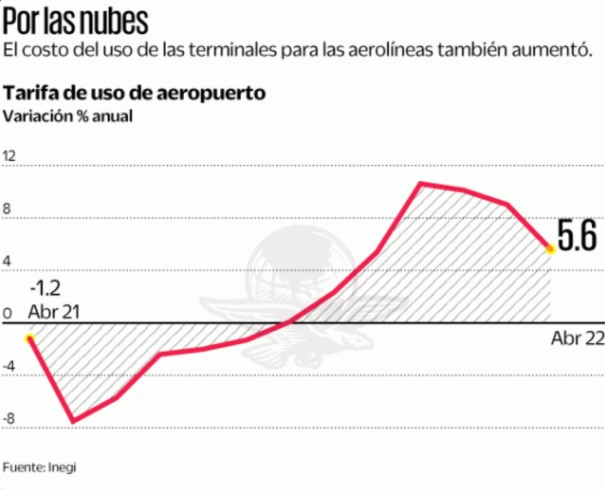
He explained that there is no investment in the sector or in the AICM because the Airport Use Fee (TUA) has been committed for 30 years to pay bondholders who lent for the Texcoco airport: "We are talking about 2 billion dollars," he explained.
“That is why Benito Juárez is falling apart,” he stressed.
The most important source of income for AICM and all airports in the world is the TUA and, in the case of Benito Juárez, it accounted for 65% of its income last year.
If AICM were in good shape, in operational, financial and technological conditions, it could operate jointly and simultaneously with AIFA, "but this is not the case, one is moribund and the other does not have the size and capacity to absorb the operations of the other."
Machorro said that, for now, the 31 investment projects for the aeronautical sector face budgetary problems that make it unlikely that the next visit for the technical review to be carried out by the Federal Aviation Administration (FAA) of the United States will allow Mexico to return to Category 1.
As of March, information from the SHCP and SICT indicates that there are difficulties in the five main investment projects regarding the resources that were expected to be allocated to them this year.
In the case of the restructuring of airspace and navigation procedures, which involves the purchase of equipment to update the system that integrates the airports of Mexico City, Toluca, Puebla and Cuernavaca, it was originally scheduled to be completed by the end of 2021, but they asked to postpone its completion until next December, meaning that the AIFA started without the system being fully ready.
Regarding the Maintenance and Rehabilitation Program of Runways 05R-23L and 05L-23R at the AICM, which includes cold cutting work on the existing asphalt that must be replaced to correct cracked and deformed areas, as well as other needs, it has a cost of 390 billion pesos and has a physical progress of only 16%.
This program was authorized for 499 million this year, but was given around 192 million.
The replacement of radio navigation aid systems, designed to ensure that aircraft approach and takeoff operations at airports in Pachuca, Loreto, Monclova, San José del Cabo, Villahermosa, San Quintín, Minatitlán, Ixtepec, Tuxtla Gutiérrez, La Paz and Monterrey, continue to operate with high security standards, has not yet been completed, by replacing equipment that has been in operation for more than 15 years.
This project has a cost of 475 million, but despite its importance, it has a physical progress of 0% and it was also necessary to reschedule it.
Source: El Universal