Go to main content
shutterstock 2160581013 scaled 1

Expropriation of the U-3400 Hydrogen plant at the Tula refinery

Executive Summary:

  • On April 18, 2024, the Decree (the “Decree”) was published in the Official Gazette of the Federation (“DOF”) by which the U-3400 hydrogen production plant, located on the 6,451.78 m² land fraction, inside the Miguel Hidalgo refinery, Tula de Allende, state of Hidalgo, in favor of Pemex Transformación Industrial, is expropriated for reasons of public utility.

  • The immediate execution of the expropriation is ordered, which implies the permanent occupation of the U-3400 hydrogen plant for the benefit of Pemex Transformación Industrial. This includes all assets and facilities identified in the appraisal report with the sequential numbers 02-24-99 and generic G-38000-1-ZNB. In addition, the immediate provision of services and the exercise of the corresponding rights are required.

Mexican President Andrés Manuel López Obrador (AMLO) has issued a decree for the expropriation of the U-3400 hydrogen production plant, located at the Miguel Hidalgo refinery in Tula de Allende, Hidalgo, in favor of Petróleos Mexicanos (“Pemex”). This is done as part of efforts to promote the transition towards a more sustainable energy industry and ensure the efficiency, security and sustainability of the country’s energy supply.

The U-3400 plant has a capacity of 2.1 million m³/day of high-purity hydrogen (99.9% mol), which is essential for the production of hydrogen used in desulfurization processes. These processes are necessary for the production of fuels with low sulfur levels, thus complying with current environmental regulations and sustainable development goals.

This plant supplies hydrogen to hydrodesulfurization facilities for gasoline, diesel and other petroleum products. Demand for these products is constantly increasing due to the need to reduce the sulfur content in fuels to protect the environment.

Pemex Transformación Industrial (“Pemex Tri”) will be the beneficiary of this expropriation, which is in line with the government’s strategy to strengthen Pemex as a driver of national economic development. Pemex Tri has the permit to carry out oil refining activities, regulated in terms of industrial, operational and environmental safety.

This plant supplies hydrogen to hydrodesulfurization facilities for gasoline, diesel and other petroleum products. Demand for these products is constantly increasing due to the need to reduce the sulfur content in fuels to protect the environment. Pemex Transformación Industrial (“Pemex Tri”) will be the beneficiary of this expropriation, which is in line with the government’s strategy to strengthen Pemex as an engine of national economic development. Pemex Tri has the permit to carry out oil refining activities, regulated in terms of industrial, operational and environmental safety.

The decree not only provides for immediate expropriation, but also establishes guidelines for fair economic compensation, based on an appraisal issued by the Institute for Administration and Appraisal of National Assets. In addition, Pemex Tri is instructed to register in the Federal Public Property Registry and in the corresponding state Property Registry, as well as to notify the affected parties.

This measure is part of the government's ongoing efforts to ensure self-sufficiency in fuel production and move towards a more sustainable energy industry that is less dependent on external sources.

Expropriation is justified by virtue of the public interest, guaranteeing the right to a healthy environment and promoting the development and well-being of the population.

Considering that hydrogen production, essential for clean fuels, is directly under the responsibility of Pemex Tri to ensure efficient production of clean fuels.

Links to the post: https://sidof.segob.gob.mx/notas/5723743

shutterstock 2213241189 scaled 1

Approval by the Senate of the Republic of the Draft Decree to Reform the Amparo Law

Executive Summary:

  • On April 17, 2024, the Senate of the Republic approved the Initiative of the Draft Decree to reform the Amparo Law, which seeks to eliminate the possibility of exceptionally granting a provisional suspension, as well as limiting the scope of the precautionary measure only to the party that promotes the trial.

  • Following the approval of the initiative, the reform project approved by the Senate of the Republic raises concerns about the restriction of judicial discretion and independence, in addition to being a regressive measure to human rights and individual guarantees recognized by the Political Constitution in favor of its citizens.

On April 17, 2024, the Senate of the Republic approved by majority vote the Draft Decree amending Articles 129 and 148 of the Amparo Law, Regulatory of Articles 103 and 107 of the Political Constitution of the United Mexican States.

In this regard, the project aims to (i) eliminate the power of the jurisdictional body to exceptionally grant the provisional suspension of the act claimed in the amparo, when it deals with certain sensitive issues, such as the use of natural resources owned by the nation, as well as (ii) in the case of claiming the unconstitutionality of general norms, prevent the suspension that may be granted from being set with general effects; that is, the requested suspension should only cover the party that promotes the lawsuit and not in favor of the entire community.

In this regard, it is important to note that the provisional suspension established in article 129 of the Amparo Law is a precautionary measure granted exceptionally by the Judicial Branch of the Federation, in order to avoid the violation of human rights of those who promote the trial of guarantees or constitutional trial, until the incidental sentence is held and a decision is made regarding the definitive suspension.

Based on the above, and although the submission of said project to the Chamber of Deputies for discussion is pending, based on the criteria upheld therein, we consider that said reform is contrary to human rights, individual guarantees and the principle of progressiveness thereof provided for in our Federal Constitution, putting at risk collective and individual rights, as well as the effectiveness of judicial resolutions, directly restricting their discretion and the balanced analysis of the specific case in the face of the possible impact on public order or the social interest.

shutterstock 2227442627

Marriott acquires certain strategic assets of City Express Hotels

Santamarina + Steta advised Marriott International, as a local firm, in the acquisition of certain assets of City Express Hotels for $100 million dollars; the acquisition involved a portfolio of brands – City Express, City Express Plus, City Express Suites, City Express Junior and City Centro –, associated brands, domains and the City Premios loyalty program. The Santamarina + Steta team was led by Aaron Levet, Alberto Saavedra y Martin Cortina, who had the support of Efraín Olmedo, in the field of intellectual property, and David Raziel Celis, from the transactional team.

Gibson, Dunn & Crutcher participated as lead firm, led by partners Stephen Glover and Alexander Orr.

The operation, which was announced in October 2022, was formally concluded on May 2, 2023, following, among others, the authorization of the concentration by the Federal Economic Competition Commission. Our partner, Vicente Grau, with the support of Yakov Y. Kobets y Sofia Ramirez, assisted in obtaining such approval.

shutterstock 530884738 scaled 1

Reform to the General Law on Credit Securities and Operations and the General Law on Auxiliary Credit Organizations and Activities

Executive Summary:

  • On March 26, the Decree was published amending, adding to and repealing various provisions of the General Law on Credit Securities and Operations and the General Law on Auxiliary Credit Organizations and Activities.
  • In general terms, the reform is a first step towards the dematerialisation of securities.
  • As this is a pilot legislation, more profound changes are anticipated in the future.

On Friday, March 26, 2024, the Decree amending, adding to, and repealing various provisions of the General Law on Credit Instruments and Operations (“LGTOC”) and the General Law on Auxiliary Credit Organizations and Activities (“LGOAAC”) (the “Decree”) was published in the Official Gazette of the Federation. In general terms, the reform is a first step towards the dematerialization of credit instruments.

Article 5 of the LGTOC now defines negotiable instruments as “the documents necessary to exercise the literal right stated therein, regardless of whether they are issued by written or electronic means.” Electronic instruments will be considered data messages under the terms of the Commercial Code, so they must be issued using technological means that allow such issuance, as well as their transmission, reception, delivery or processing.

In turn, the above must be carried out in an electronic system that allows to know, reliably, the identity of the parties involved, the information contained in the title, and in the case of transfers, the continuity of endorsements and the existence and circulation of the same. For the purposes of delivery of the title, it will be considered made through said system; and in the case of the signature, this requirement will be considered fulfilled when it is attributable to the signatory according to the Commercial Code itself.

As this is a pilot legislation, anticipating more profound changes in the future, the first institution to be homogenized is the one related to general deposit warehouses and their deposit certificates, which must now also be issued through the electronic systems that each warehouse determines, complying with the requirements contained in the LGTOC and the LGOAAC.

In addition, the Decree provides for the creation of the RUCAM (Single Register of Certificates, Warehouses and Merchandise) as a new register in which general warehouses must record the issuance and cancellation of deposit certificates, as well as the merchandise they cover. In addition, sales notices and other annotations indicated by the LGOAAC and other applicable laws will be registered in the RUCAM.

Pursuant to the Transitory Articles of the Decree, the Federal Executive and the National Banking and Securities Commission (“CNBV”) have 180 business days from the date of entry into force of the Decree to adjust all secondary regulations (circulars, regulations, provisions) in accordance with it. Additionally, the CNBV must issue the relevant rules in light of the content of the Decree within the same period.

For their part, general deposit warehouses have a period of 18 months from the date of entry into force of the Decree to adjust their operation and issue electronic deposit certificates. They may continue issuing physical certificates only until they begin to issue electronic certificates or the aforementioned period is met, at which time they may not continue issuing physical certificates.

shutterstock 2303961841 scaled 1

The Mexican Social Security Institute (IMSS) issues guidelines on teleworking

Executive Summary:

  • On March 22, 2024, the agreement issued by the H. Technical Council of the Mexican Social Security Institute approving criterion 01/2024/NV/SBC-LSS-27-I was published in the Official Gazette of the Federation, which is related to the correct integration of the base salary for contributions in accordance with the Social Security Law (LSS), specifically in relation to benefits derived from teleworking in accordance with the Federal Labor Law (LFT).

  • Under this criterion, those who advise, counsel, provide services or participate in the implementation of practices such as providing employees with cash amounts, via payroll or by any other means, pretending that it is beneficial with respect to teleworking, are considered to be carrying out an improper tax practice.

On March 22, 2024, the agreement issued by the H. Technical Council of the Mexican Social Security Institute in an ordinary session held on February 27, 2024, was published in the Official Gazette of the Federation, by which criterion 01/2024/NV/SBC-LSS-27-I was approved, which is related to the correct integration of the base contribution salary in accordance with the Social Security Law (LSS), specifically in relation to benefits derived from teleworking in accordance with the Federal Labor Law (LFT).

Article 27 of the LSS establishes that work instruments such as tools, clothing and similar items, given their nature, are excluded from the integration of the contribution base salary (SBC).

The criteria adopted by the IMSS establishes that these concepts are similar to the teleworking benefits mentioned in sections I and III of numeral 330-E of the LFT - providing, installing and maintaining the equipment necessary for teleworking, such as computer equipment, ergonomic chairs, printers, and assuming the costs of telecommunications services and the proportional part of electricity - and, consequently, they should not be part of the integration of the SBC.

However, it is emphasized that these are part of the expenses that the employer has to make when offering the appropriate means for the provision of work, so the relevant information must be stipulated in a contract, indicating the description and amount to be paid for said concepts.

On the other hand, it is highlighted that excluding from the SBC the benefits related to teleworking derived from the employer's obligations will be valid when the employment relationships actually derive from teleworking, since if another form of subordinate work organization is proven, it would be considered a simulation.

Finally, it was established that under this new criterion it will be considered that an improper tax practice is being carried out in the area of ​​social security:

  • Anyone who gives workers amounts in cash, via payroll or by any other means, pretending that these are benefits related to teleworking derived from employer obligations consisting of providing, installing and maintaining the equipment necessary for teleworking, as well as assuming the costs corresponding to the payment of telecommunications services and the proportional part of electricity, regardless of the name used in the accounting records, with the purpose of excluding them as part of the SBC and thus avoiding the payment of social security contributions for remuneration paid to workers.

  • Anyone who advises, counsels, provides services or participates in the implementation or execution of the practices indicated.

  • The certified public accountant who issues a “clean and unqualified” compliance opinion in the social security report of employers who resort to any of the aforementioned conduct.

Link to the publication: https://www.dof.gob.mx/nota_detalle.php?codigo=5721189&fecha=22/03/2024#gsc.tab=0

shutterstock 548715466

Workshop on the Evolution of the Legal System in Electrical Matters

We invite you to register for the hybrid workshop organized by the Spanish Chamber of Commerce (CAMESCOM), in which our partner Norma Alvarez participates as a speaker.

The objective of the workshop is to learn about the evolution of the legal and regulatory system prior to the Electricity Reform, as well as the most relevant changes to date. Professionals interested in learning about the most relevant changes in the legal and regulatory system in electricity matters since the implementation of the Energy Reform are invited to participate.

The face-to-face sessions will be held at CAMESCOM (Av. Homero 1430, Polanco, Miguel Hidalgo, Mexico City). The online sessions will be held via the Zoom platform.

The workshop has a recovery cost of:

  • CAMESCOM Partners: $6,000 + VAT
  • Non-Members: $9,000 + VAT

To register, you must send an email to aulacamescom@camescom.mx.

Our Expert

shutterstock 1350699089 scaled 1

REPSE, current affairs: Legal and practical aspects

Perez Mena Orozco and Santamarina + Steta, in collaboration with the Guanajuato Automotive Cluster, invite you to this talk where experts on the subject will discuss and analyze the legal and practical aspects related to the Registry of Specialized Service Providers (REPSE).

To attend the event, please RSVP at the following link:

Our Experts:

 class =

Andres Rodriguez

Santamarina + Steta

Employment

 class =

Victor Coria

Santamarina + Steta

Employment

 class =

Regina Orozco

Perez Mena & Orozco

Compliance

 class =

Sandra Perez Mena

Perez Mena & Orozco

Constitutional

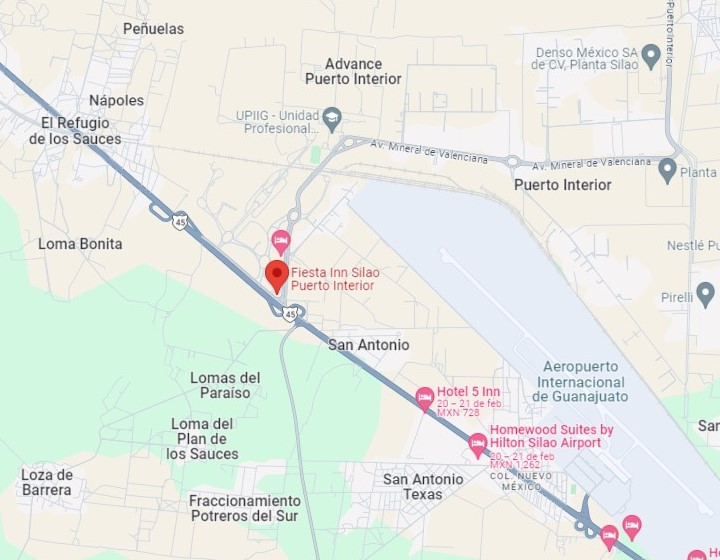
April 10, 2024 | 11:00 AM

Fiesta Inn Silao Inner Harbor
Silao, Guanajuato

 class =
shutterstock 2266147447 1 scaled 1

Mexicans require a visa or electronic authorization “eTA” to travel to Canada

As of February 29, 2024, the Government of Canada has modified the rules for entering the country. Mexicans will be required to obtain a visa or an electronic authorization “eTA” if they have a valid and current non-immigrant visa issued by the government of the United States of America or if they have been holders of a Canadian visa during the last 10 years and are traveling to Canada by plane.

All eTAs issued to Mexican passports before 10:30 p.m. Mexico time on February 29, 2024 will no longer be valid, except for eTAs linked to Mexican passports with a valid Canadian work or study permit.

I'm going to travel by plane to CanadaI have a valid US visaAn Electronic Travel Authorization (eTa) application is required.
I'm going to travel by plane to CanadaI have held a Canadian visitor visa in the last 10 years (Temporary Resident Visa)An eTA Electronic Travel Authorization application is required.
I'm going to travel to Canada by planeI do not have a valid US visa nor have I held a Canadian visitor visa in the last 10 years.A CANADIAN VISA application is required.
I am going to travel to Canada by train, truck, boat, cruise ship or car A CANADIAN VISA application is required.

At Santamarina + Steta we will be happy to advise you regarding this new visa requirement or other immigration matters.

shutterstock 2317830795 1

The Sustainable Future: ESG and Compliance Legal Perspectives in Mexico

Through a strategic commercial alliance between the offices Perez Mena Orozco and Santamarina + Steta, we offer comprehensive legal advice (full service) that allows us to meet all the legal needs of a wide variety of industries and sectors.

We invite you to the talk “The Sustainable Future: ESG and Compliance Legal Perspectives in Mexico” with our experts in Foreign Trade, Real Estate, Compliance and Labor issues. You will also be able to learn about the legal services that both firms offer to companies located in the Bajío region.

To attend the event, please RSVP at the following link:

January 24, 2024 | 8:30 AM

Fiesta Inn Silao Inner Harbor
Silao, Guanajuato

See you there!

shutterstock 2422226279 1

Aviva acquires Probitas Holdings

Santamarina y Steta advised, as a local firm, Aviva PLC, the largest general insurer in the United Kingdom, on the acquisition of Probitas Holdings, Ltd. and its subsidiaries, for £242 million. The transaction includes the acquisition of Probitas' fully integrated platform at Lloyd's, which encompasses its Corporate Member, Managing Agent, distribution entities and ownership rights of Syndicate 1492.

Reynolds Porter Chamberlain LLP acted as lead firm on the transaction. The Santamarina and Steta team was led by Aaron Levet, Heriberto Garza y Raziel Celis, who had the support of Mauricio Barraza, in the area of ​​insurance, and Gerardo Prieto, from the transactional team.

The Lloyd's market represents an important source of growth for Aviva, offering access to significant premium volumes, international licences and broader distribution networks. It will also allow Aviva to capitalise on its existing underwriting capabilities, broker relationships and capital base. The acquisition is subject to various regulatory approvals and is expected to close in mid-2024.

shutterstock 697566253 1

Requesting a refund of the remainder of a VAT balance in favor that has been previously credited will not be possible.

Executive Summary:

  • The Regional Plenary Session on Administrative Matters of the Central-North region, based in Mexico City, resolved that it is not feasible to resort to the general scheme for the refund of a balance in favor of value-added tax (VAT), once the crediting of said balance has been exercised.
  • This will affect the decision of taxpayers to credit or request a refund of their VAT balances.
  • However, it is recognized that there may be cases that should be brought before the tax authority, who must resolve the matter by analyzing the circumstances of the matter and based on an evaluative judgment of the evidence.

The Regional Plenary Session on Administrative Matters of the Central-North region, based in Mexico City, resolved that it is not feasible to resort to the general scheme for the refund of a balance in favor of value added tax (VAT), once the crediting of said balance has been exercised, provided for in article 6 of the law on the matter (LIVA) in force in 2018.

On February 16, 2024, in resolving a conflict of theses, the aforementioned Plenary issued Jurisprudence PR.A.CN. J/66 A (11th), by virtue of which it decided the following:

  • Although the Federal Tax Code, as a general rule, established that in the case of compensation of balances in favor, it was possible to request a refund for the total remainder, in article 6 of the LIVA, which is the special rule, there is no such alternative when it comes to the crediting of a VAT balance in favor against the tax due in the following months.
  • For the above reasons, it is not feasible to obtain a partial refund of the balance in your favor, once the credit option has been chosen and it has not been exhausted.
  • Thus, when it comes to crediting the VAT balance in favour, once this option is exercised, it is not feasible to resort to the general refund scheme, but the balance in favour must continue to be credited until it is exhausted.
  • Accordingly, if the refund of the balance in your favor has been chosen, the total amount must be returned.
  • However, it is recognized that there may be some cases in which the taxpayer can no longer continue his commercial economic activity or no longer has tax due and, therefore, is unable to continue crediting the balance in his favor, a situation that must be raised before the tax authority who must resolve the appropriate action by analyzing the circumstances of the matter and based on an evaluative judgment of evidence.

The above will undoubtedly impact the decision of taxpayers to credit or request a refund of their VAT balances, given the possibility of choosing only one way to recover them, which should be analyzed in each specific case, taking into account the consequences that each option implies.

It should be noted that, being a jurisprudence issued by the Regional Plenary on Administrative Matters of the Central-North region, said criterion is mandatory for the lower-ranking bodies of the Judicial Branch and Chambers of the Federal Court of Administrative Justice of Mexico City, State of Mexico, Nuevo León, Sonora, Coahuila, San Luis Potosí, Sinaloa, Baja California, Guanajuato, Chihuahua, Tamaulipas, Querétaro, Zacatecas, Nayarit, Durango, Baja California Sur, Tlaxcala and Aguascalientes.

Update Site

STPS modifies provisions for the renewal of the registration of individuals or legal entities that provide specialized services or execute specialized works (REPSE)

Executive Summary:

  • On February 21, 2024, the Agreement that modifies the various one by which the general provisions for the registration of individuals or legal entities that provide specialized services or execute specialized works referred to in article 15 of the Federal Labor Law are made known was published in the Official Gazette of the Federation.
  • The amendment to the provisions seeks to provide certainty and clarity to the requirements and processes that must be carried out to renew registration with the REPSE.
  • Individuals or legal entities that are registered with the REPSE must renew their registration within three months prior to the date on which its three-year validity expires, in accordance with the calendar provided by the STPS for such purposes; otherwise, the registration will be cancelled and they will be removed from the REPSE.

On February 21, 2024, the Agreement that modifies the various one by which the general provisions for the registration of individuals or legal entities that provide specialized services or execute specialized works referred to in article 15 of the Federal Labor Law (REPSE), issued by the Ministry of Labor and Social Welfare (STPS), were published in the Official Gazette of the Federation.


These provisions regulate the process of registration, denial, cancellation and renewal of registration with the REPSE. The modification of the provisions seeks to provide certainty and clarity to the requirements and processes that must be carried out for the renewal of the REPSE.


The modifications that stand out are the following:

  1. Individuals or legal entities that are registered with the REPSE must renew their registration every three years. The 3-year validity of the registration will be counted from the date on which they were registered with the REPSE, regardless of whether they have made an update or modification to their registration.
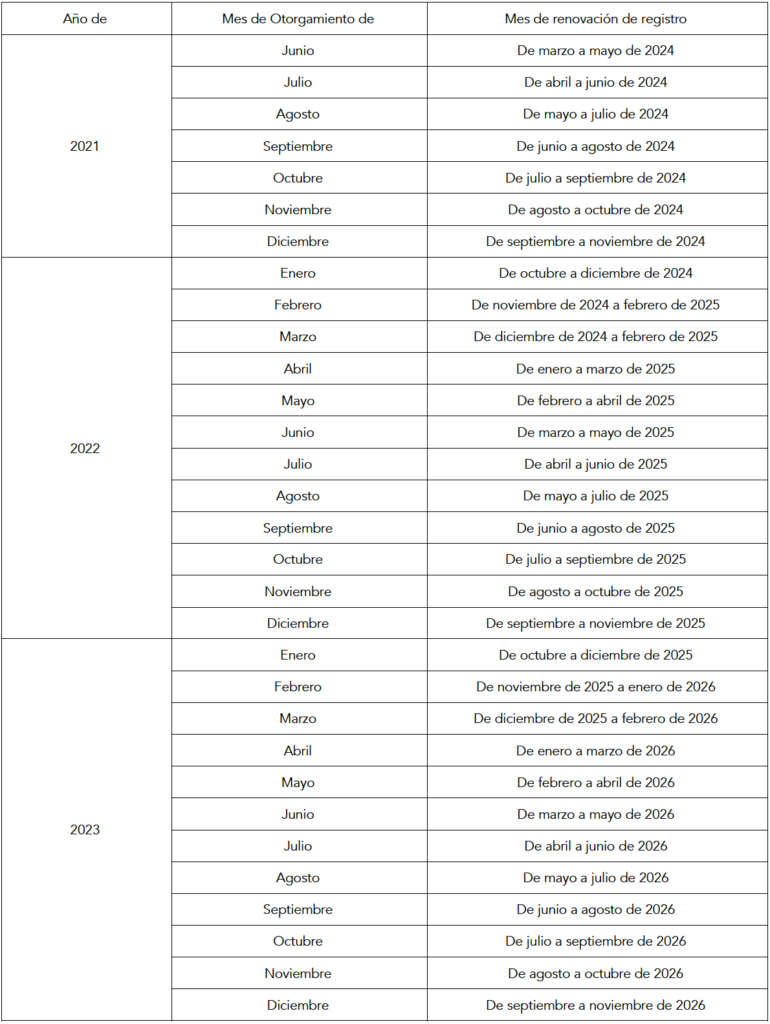
  1. The renewal of said registration must be processed within a period of three months prior to the date on which its validity expires. For such purposes, the STPS enabled within the platform http://repse.stps.gob.mx a new module called “Registration Renewal”, which can only be accessed during the period defined by the STPS, in accordance with the validity of your registration notice and the following calendar:
Screenshot 2024 02 22 at 12 14 24 pm 770x1024
  • Individuals or legal entities registered with the REPSE may only carry out their renewal process on the dates established in the calendar above. Once this period has expired, the platform will automatically disable the renewal module.
  • If the registration is not renewed within the established period, the registration will be cancelled and the applicant will be removed from the REPSE, for which reason a new registration process must be carried out. In this case, the validity of the 3 years of registration will be counted from the new registration.
  • Once the registration has been renewed, the provider of specialized services or executor of specialized works must inform the beneficiaries of the specialized services or works of the renewal of said registration.
  • During the renewal process, they must again provide information and documentation under oath, in accordance with the platform's requirements.
  • At the date on which the renewal application is made, they must be up to date with their tax and social security obligations with the Tax Administration Service, the Mexican Social Security Institute and the National Workers' Housing Fund Institute.
  • Specialized services or works that wish to be renewed must be included within their corporate purpose and, the Agreement specifies that, in the case of natural persons, within their proof of tax situation.
  • The STPS must decide on the application for renewal of the registration within 20 business days after receiving the application. If the requirements necessary to obtain the registration are met, the STPS will proceed to carry out the renewal and issue the corresponding renewal notice.

The Agreement will enter into force on the day following its publication and its full text can be consulted at the following link:
https://www.dof.gob.mx/nota_detalle.php?codigo=571 7562&fecha=21/02/2024#gsc.tab=0